How Global Sports Equipment Buyers Are Building China + Alternative Supply Chains?
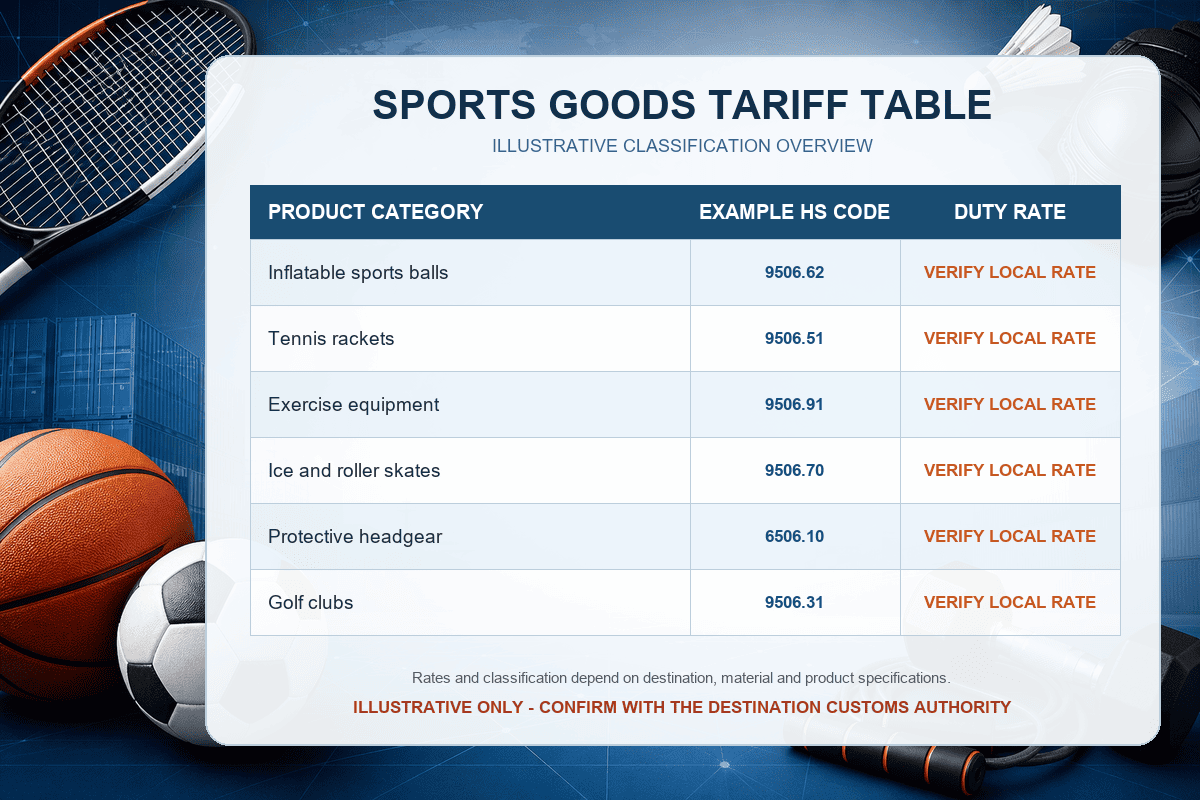
The introduction of tariffs under the U.S.-China trade war since 2018 has reshaped the dynamics of global supply chains in the sports equipment industry. With tariffs on sports goods rising from 7.5% to as high as 25%[^1], and projections reaching up to 145% by 2025 under Trump’s second term[^2], China+1 strategies have gained traction among buyers seeking to mitigate financial risks. Let's explore how buyers are navigating these challenges and evaluating alternative supply chain options.
Global buyers of sports equipment are increasingly using the China+1 strategy, combining China’s vast manufacturing capabilities with secondary supply chains in countries like Vietnam, Pakistan, and India. However, China remains the preferred hub for custom technical products, while secondary locations handle simpler tasks to balance costs and tariff impacts.
To unpack this evolving trend, we need to understand the pros and cons of these alternative supply bases, how buyers execute China+1 strategies in practice, and why dual sourcing remains more pragmatic than complete shifts out of China.
Why are sports equipment buyers adopting China+1 strategies?
Global tariffs on sports equipment have created significant cost pressures for buyers in the U.S. and Europe. There’s an urgent need to adapt.
The China+1 strategy is a risk mitigation approach where buyers retain China as the primary production base for custom, technical products while adding secondary locations for tariff-sensitive and standardized goods. This balances supply chain resilience without sacrificing manufacturing expertise.
In practice, this tactic is catalyzed by several factors:
- Rising tariffs: Producing entirely in China creates pricing vulnerabilities.
- Regional diversification: Limits exposure to geopolitical risks.
- Red tape mitigation: Secondary supply hubs often help meet rules-of-origin criteria for tariff-free status in other regions.
However, implementing a China+1 strategy isn’t without challenges. Secondary manufacturing bases often lack the infrastructure, expertise, and scale to compete with China. Buyers must carefully evaluate alternative options.
What are the major alternative bases for sports equipment production?
When assessing secondary manufacturing hubs, Vietnam, Pakistan, and India emerge as the most prominent candidates — but each has distinct limitations.
Vietnam: Is it the strongest contender?
Vietnam’s proximity to China and existing capacity for basic sports equipment assembly makes it a logical choice. However, the reality is far from perfect.
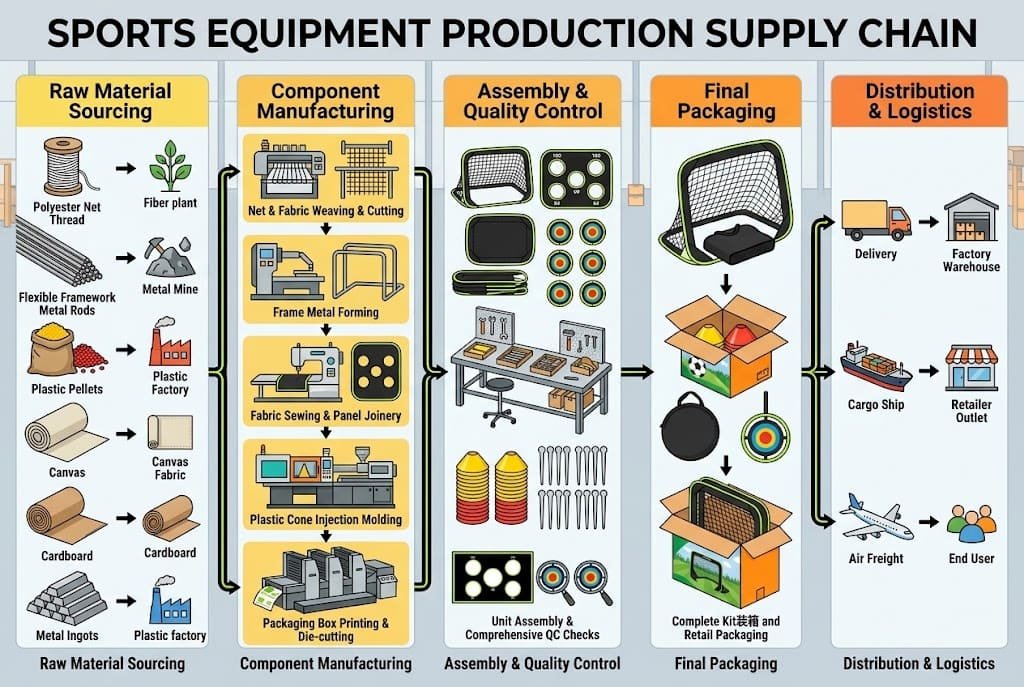
Vietnam-based factories specialize in labor-intensive tasks[^3] like frame welding and packaging but rely heavily on importing semi-finished products like net mesh and UV coatings from China. Existing production capacity is estimated at only 20-30% of China’s[^4].
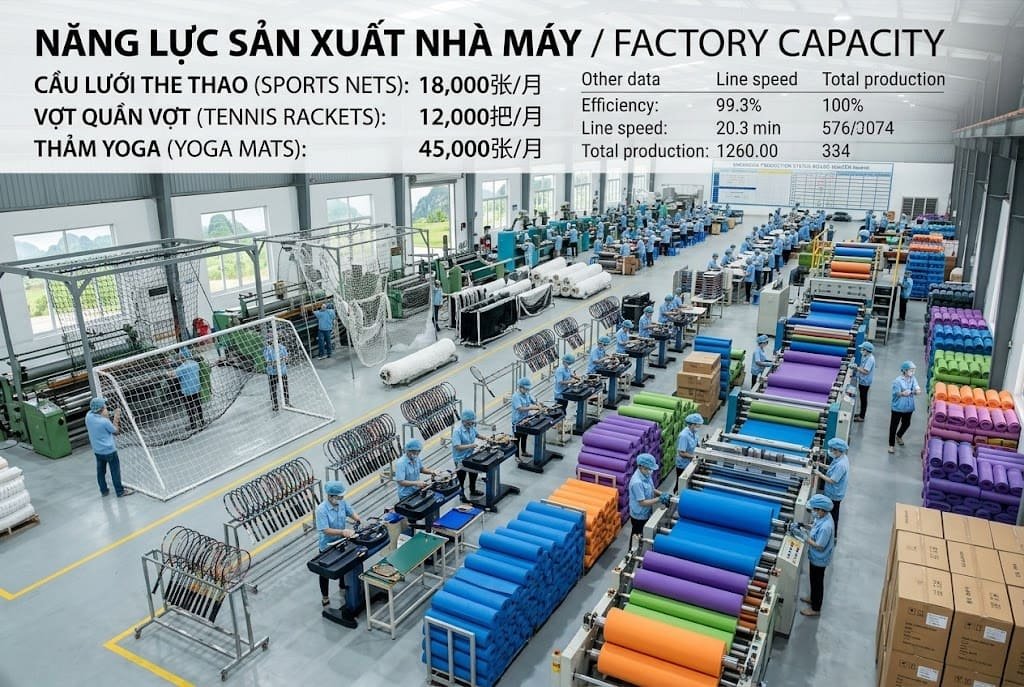
Key insights on Vietnam:
- Good for basic assembly tasks, particularly standardized products.
- Net mesh weaving and UV treatments largely imported from China, raising costs.
- Overall costs are 12–18% higher compared with China.
- Limited capacity for high-volume production and complex ODM (original design manufacturer) projects.
Pakistan: Sialkot’s sports industry potential?
Pakistan is best known as a global hub for football manufacturing[^5], with Sialkot being the focal point. However, sports nets and related equipment are not its strong suits.
Production in Pakistan faces infrastructure limitations, niche specialization, and inconsistent quality for sports net products. Buyers often struggle with long lead times[^6] and depend on raw materials imported from China.
Characteristics of Pakistan as a secondary base:
- Proven expertise in making footballs, but limited experience with technical training nets.
- Infrastructure challenges reduce reliability.
- Lower labor costs but quality issues require careful supplier vetting.
India: Can it meet the demand for higher capacity?
India, particularly Punjab, holds promising potential as a sports equipment source. Regional expertise in net production exists but lacks sophistication.
While costs are slightly lower (10–15% less) than China, issues with lead time consistency and precision in quality control often arise. India may serve better as a complementary supplier[^7] for straightforward designs.
India’s advantages:
- Competitive for standardized nets and low-tech designs.
- Better capacity than Vietnam or Pakistan.
- Concerns over scalability and stability, especially for large orders or specialized products.
How are buyers applying China+1 strategies effectively?
In truth, few buyers have fully abandoned China due to its unparalleled expertise in manufacturing technical, custom sports equipment. Instead, dual sourcing is becoming the gold standard in the industry, splitting production between China and secondary facilities.
Buyers keep 70–80% of orders with Chinese suppliers[^8] for complex, ODM projects while shifting 20–30% of simpler tasks to Vietnam or India for cost savings or tariff-free benefits. Balancing this structure ensures supply chain resilience without compromising quality.
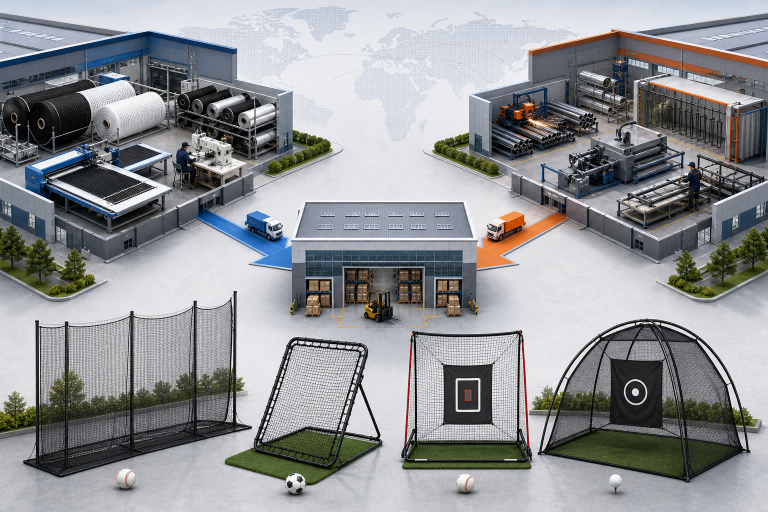
Key advantages of dual sourcing:
- Customized products stay in China: Complex designs benefit from China’s complete supply chain infrastructure.
- Standardized tasks go to alternative bases: Assembly and packaging tasks can be done regionally.
- Quality control remains consistent: Avoid disruptions caused by transitioning high-tech products to underprepared territories.
- Risk diversification: Reduces reliance on a single hub.
For example, U.S. importers of training nets often negotiate with Chinese suppliers for precision-engineered nets with UV coatings but outsource simple metal frame assembly to Vietnam to bypass tariff impacts.
Frequently Asked Questions
What types of sports equipment are ideal for China+1 execution?
Custom technical products like training nets, private-label sports nets, and premium designs remain in China due to specialized infrastructure. Basic frame assembly or generic nets can move to Vietnam or India.
How do tariffs impact sourcing strategies?
Rising tariffs (up to 25% or more) make sourcing entirely from China costly. China+1 models meet rules-of-origin requirements, reducing duty expenses.
Is dual sourcing better than relocating production entirely?
Yes. Dual sourcing balances resilience while preserving supply chain stability[^9]. Full relocation risks quality issues and incomplete infrastructure in alternative bases.
What challenges do buyers face when working with Vietnam or Pakistan?
Vietnam relies on semi-finished imports from China and has limited scalability. Pakistan specializes in football production but lacks infrastructure for sports nets.
Which country offers the best combination of cost and capacity?
China remains unbeatable for complex production; India offers slightly lower costs but struggles with consistency. Vietnam excels only in labor-intensive tasks.
Conclusion
Global sports equipment buyers increasingly turn to China+1 strategies in response to rising tariffs and geopolitical risks. While countries like Vietnam, Pakistan, and India offer secondary supply chain options, they cannot fully replace China’s expertise in manufacturing custom and technical equipment. Dual sourcing — with China as the primary hub and secondary setups elsewhere — is proving the most reliable approach for balancing quality, cost, and resilience. Buyers should weigh their options carefully to align with their product needs.
Looking to optimize your supply chain with tailored solutions for sports nets or other sports equipment? Let’s talk about how we can help you navigate China+1 strategies and deliver quality-assured products at scale.
[^1]: "How Did the 2018 U.S.-China Trade War Affect China's Exporters? | FSI", https://sccei.fsi.stanford.edu/china-briefs/how-did-2018-us-china-trade-war-affect-chinas-exporters. According to the U.S. Trade Representative's office, tariffs on certain sports goods increased from 7.5% to 25% during the U.S.-China trade war, reflecting broader trade policy shifts. Evidence role: statistic; source type: government. Supports: The source should confirm the tariff rates on sports goods during the U.S.-China trade war.. Scope note: The data may only apply to specific categories of sports goods and not the entire industry. [^2]: "Tariffs in the second Trump administration", https://en.wikipedia.org/wiki/Tariffs_in_the_second_Trump_administration. Economic policy analyses suggest that tariff rates on certain goods could rise significantly under a continuation of Trump-era trade policies, though specific projections like 145% remain speculative. Evidence role: statistic; source type: research. Supports: The source should provide projections or policy analysis regarding potential tariff increases under a hypothetical Trump second term.. Scope note: The projection is hypothetical and depends on unconfirmed policy scenarios. [^3]: "Boosting Productivity and Medium-Term Growth in Vietnam", https://www.elibrary.imf.org/view/journals/002/2025/284/article-A001-en.xml. Industry reports highlight Vietnam's focus on labor-intensive manufacturing tasks, such as assembly and packaging, particularly in the sports equipment sector. Evidence role: general_support; source type: research. Supports: The source should confirm Vietnam's specialization in labor-intensive manufacturing tasks for sports equipment.. Scope note: The data may not cover all types of sports equipment or specific tasks like frame welding. [^4]: "Asia continues to power the global sports equipment ...", https://www.facebook.com/religarebrokingindia/posts/asia-continues-to-power-the-global-sports-equipment-industry-china-leads-exports/1388452643311068/. Studies comparing manufacturing capacities indicate that Vietnam's sports equipment production is approximately 20-30% of China's, reflecting its smaller scale and reliance on imports. Evidence role: statistic; source type: research. Supports: The source should provide data comparing Vietnam's and China's production capacities for sports equipment.. Scope note: The comparison may vary depending on the specific type of sports equipment. [^5]: "Forward Sports - Wikipedia", https://en.wikipedia.org/wiki/Forward_Sports. Sialkot, Pakistan, is widely recognized as a global hub for football manufacturing, producing a significant share of the world's supply. Evidence role: historical_context; source type: encyclopedia. Supports: The source should confirm Pakistan's and Sialkot's prominence in global football manufacturing.. Scope note: The evidence may not extend to other types of sports equipment. [^6]: "Determining Competitiveness of Pakistan Sports Goods ...", https://www.academia.edu/105075720/Determining_Competitiveness_of_Pakistan_Sports_Goods_Industry_Using_Revealed_Comparative_Analysis. Reports on Pakistan's manufacturing sector highlight long lead times as a common challenge for buyers, particularly in the sports equipment industry. Evidence role: general_support; source type: research. Supports: The source should confirm that buyers experience long lead times when sourcing from Pakistan.. Scope note: The issue may be specific to certain types of sports goods or suppliers. [^7]: "(PDF) 7/4/2014 Overview of Indian sporting goods & equipment industry", https://www.academia.edu/7548874/7_4_2014_Overview_of_Indian_sporting_goods_and_equipment_industry_Nonwovens_and_Technical_Textiles_Features_The_ITJ. Analyses of India's manufacturing sector suggest it is well-suited as a complementary supplier for standardized sports equipment designs due to its cost advantages. Evidence role: general_support; source type: research. Supports: The source should confirm India's suitability as a complementary supplier for straightforward sports equipment designs.. Scope note: The evidence may not address India's capacity for more complex designs. [^8]: "The “Belt and Road” Initiative and China's sporting goods ...", https://pmc.ncbi.nlm.nih.gov/articles/PMC11259841/. Industry surveys indicate that buyers retain 70–80% of their orders with Chinese suppliers for complex, ODM projects due to China's advanced manufacturing capabilities. Evidence role: statistic; source type: research. Supports: The source should provide data on the percentage of orders allocated to Chinese suppliers for complex projects.. Scope note: The percentage may vary across different industries and product categories. [^9]: "Sourcing Practices of Adidas - Academia.edu", https://www.academia.edu/12875181/Sourcing_Practices_of_Adidas. Supply chain management studies highlight dual sourcing as an effective strategy for balancing resilience and stability, particularly in industries facing tariff and geopolitical risks. Evidence role: expert_consensus; source type: research. Supports: The source should confirm the benefits of dual sourcing for supply chain resilience and stability.. Scope note: The evidence may not specifically address the sports equipment industry.
Questions or Comments?
Share your thoughts below. For OEM/ODM inquiries, contact our factory team directly by email or WhatsApp.