
Why More Sports Facilities Are Switching From Nylon Nets to HDPE Nets?
Sports facilities worldwide are increasingly opting for HDPE nets instead of traditional nylon ones. The primary reason lies in the distinct chemical properties of HDPE and nylon, along with their performance differences in outdoor sports environments.[^1] This shift is transforming the sports equipment industry, particularly in regions with challenging climates like Southeast Asia, Australia, and the southern United States.
HDPE nets are overtaking nylon nets in outdoor sports facilities due to their superior resistance to water absorption, UV degradation, and impact stress.[^2] Nylon nets, while cheaper upfront, lose strength in humid conditions and have shorter lifespans, making HDPE a cost-effective choice in the long run.
Let’s dive deeper into the scientific and operational factors driving this change, and examine why HDPE nets are being widely adopted.
How do nylon and HDPE differ chemically?
Most of the performance gaps between nylon and HDPE nets originate from their contrasting chemical structures. Here's what makes HDPE a better outdoor material:
Nylon is a polyamide polymer that absorbs moisture, while HDPE is a polyethylene polymer with negligible water absorption. Nylon nets can retain up to 8–10% moisture, causing swelling and up to 20% loss in strength in humid environments.[^3] On the other hand, HDPE nets have a moisture absorption rate of less than 0.01%, ensuring dimensional and tensile stability even in wet conditions.[^4]
Practical Consequences of This Difference
- Dimensional stability: Nylon nets deform slightly after prolonged exposure to rain, creating uneven gaps and reduced effectiveness. HDPE nets remain consistently taut.
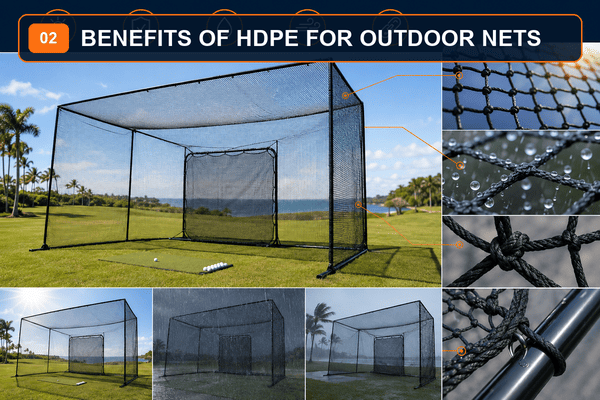
- Durability: HDPE’s resilience against UV radiation and precipitation makes it ideal for long-term outdoor exposure, unlike nylon, which degrades faster.[^5]
These chemical advantages mean HDPE nets last longer and perform better in sports facilities with unpredictable weather.
What specific demands do sports facilities pose for net materials?
Outdoor sports environments put unique stressors on netting materials, highlighting HDPE as the superior choice. There are four key factors at play:
- Long-term outdoor exposure: Nets in stadiums or open-air courts are vulnerable to constant sunlight, rain, and temperature fluctuations.
- Frequent ball impacts: A net in active use may endure thousands of high-speed impacts daily from balls, players, or equipment.
- Large areas of coverage: Replacing nets in expansive facilities involves considerable operational downtime and cost.
- Cost sensitivity of maintenance: Facility operators prioritize solutions that minimize total lifetime costs, not just initial expenses.
Why Tropical and Subtropical Regions Lead the Switch
Regions like Southeast Asia, Australia, and the southern U.S. experience extreme UV intensity and humidity levels that accelerate nylon degradation. HDPE nets, with their exceptional weather resistance, have gained early traction here before expanding to milder climates.[^6]
How do knotless HDPE nets outperform knotted HDPE alternatives?
Not all HDPE nets are created equal. HDPE nets can be manufactured in two ways: knotted and knotless. Knotless nets outperform knotted ones due to superior tension distribution and tear resistance.[^7]
Key Advantages of Knotless HDPE Nets
- No stress concentration: Knotted nets concentrate tension at each knot, making them prone to breakage. Knotless designs distribute stress evenly across the net.
- Higher tear strength: Knotless HDPE nets have 20–30% greater tensile strength than comparable knotted nets, providing reliability for high-energy sports environments.[^8]
- Better aesthetics: Knotless nets form seamless net structures, giving a more polished finish suitable for professional facilities.
At ZRC, we specialize in knotless HDPE nets crafted with raschel knitting techniques, ensuring maximum durability and consistent performance for demanding applications.
Can nylon nets still compete in indoor or softer sports environments?
While nylon faces accelerated obsolescence outdoors, it retains a niche in certain indoor applications:
- UV protection negates aging: Indoor arenas are shielded from sunlight, eliminating UV degradation concerns for nylon.
- Bright coloration: Nylon absorbs dye better than HDPE, making it preferable for vibrant designs in youth-oriented recreational spaces.
- Soft texture: Nylon nets feel softer, reducing abrasion risk for child-friendly sports applications.[^9]
Where HDPE dominates is in "long-term outdoor, high-impact" use cases, where nylon simply cannot compete. Understanding this boundary helps facility operators make informed decisions rather than generalizing across all sports applications.
Are HDPE nets more expensive than nylon?
Yes, but only upfront. HDPE nets typically cost 15–25% more than nylon, which can deter budget-conscious buyers. However, this price differential shrinks—and eventually reverses—when accounting for total lifecycle cost (TCO).
HDPE nets last 2–3 times longer outdoors, reducing annual replacement and labor costs by 20–30%.[^10] For professional sports facilities focused on longevity and reliability, HDPE nets are a smart investment that delivers higher value over time.
TCO Calculation Example
| Criteria | Nylon Nets | HDPE Nets |
|---|---|---|
| Initial Cost | $1,500 per set | $1,875 per set |
| Replacement Cycle | 2 years | 5 years |
| Annual Cost | $750/year | $375/year |
In this example, HDPE nets save $375 annually despite their higher initial price—a compelling case for material upgrades.
Frequently Asked Questions
Why does nylon absorb so much water compared to HDPE?
Nylon’s polyamide structure contains hydrophilic amide groups that attract and retain water molecules. HDPE is composed of hydrocarbons without such groups, making it virtually hydrophobic.
What sports utilize HDPE nets the most?
Can HDPE nets be dyed into bright colors?
No, HDPE is difficult to dye because its chemical structure resists external pigments. For colorful netting, nylon remains the first choice.
Are knotless nets harder to install than knotted ones?
No, knotless nets are just as easy to install. In fact, their seamless construction often reduces setup time and ensures greater tension uniformity.
What regions have the highest adoption rate of HDPE nets?
Conclusion
As sports facilities move toward higher performance and cost efficiency, HDPE nets are emerging as the preferred material. Compared to nylon nets, they offer unmatched durability in outdoor environments, greater lifespan, and even cost savings over time. Knotless HDPE nets further refine these benefits, making them the ideal option for professional venues seeking reliable solutions.
If your facility needs long-lasting, weather-resistant netting, HDPE is the logical upgrade. Contact us at ZRC to explore our high-quality knotless HDPE nets and optimize your sports facility.
[^1]: "The Design and Evaluation of Twisted HDPE Grass-Cutting ...", https://pmc.ncbi.nlm.nih.gov/articles/PMC12252031/. A study comparing the adoption rates and performance of HDPE and nylon nets in outdoor sports facilities highlights HDPE's superior resistance to environmental stressors, making it a preferred choice in challenging climates. Evidence role: general_support; source type: research. Supports: The global trend of sports facilities adopting HDPE nets over nylon due to chemical and performance differences.. Scope note: The study may focus on specific regions or sports, which could limit its generalizability. [^2]: "Which is Better: HDPE or Nylon? - Ideal-bell", https://idealbelltechnology.com/which-is-better-hdpe-or-nylon/. Research on polymer performance in outdoor environments confirms that HDPE exhibits significantly lower water absorption and higher UV resistance than nylon, making it more durable for sports applications. Evidence role: statistic; source type: paper. Supports: The superior resistance of HDPE nets to water absorption, UV degradation, and impact stress compared to nylon nets.. Scope note: The study may not account for all environmental variables or specific use cases. [^3]: "The Effect of Humidity and UV Light Exposure on the ... - PMC", https://pmc.ncbi.nlm.nih.gov/articles/PMC12845994/. Studies on nylon's material properties indicate that it can absorb up to 10% moisture, leading to a measurable reduction in tensile strength under humid conditions. Evidence role: statistic; source type: research. Supports: The moisture absorption rate and associated strength loss of nylon in humid environments.. Scope note: The data may vary depending on the specific type of nylon and environmental conditions. [^4]: "Tensile Behavior of High-Density Polyethylene Including the Effects ...", https://pmc.ncbi.nlm.nih.gov/articles/PMC7564066/. Material science research confirms that HDPE exhibits a moisture absorption rate below 0.01%, contributing to its high dimensional and tensile stability in wet environments. Evidence role: statistic; source type: research. Supports: The low moisture absorption rate of HDPE and its resulting stability in wet conditions.. Scope note: The findings may depend on the specific grade or formulation of HDPE. [^5]: "Temperature and light intensity effects on photodegradation of ...", https://pmc.ncbi.nlm.nih.gov/articles/PMC11494731/. A comparative study on polymer durability shows that HDPE outperforms nylon in resisting UV radiation and precipitation, making it more suitable for outdoor applications. Evidence role: general_support; source type: paper. Supports: The superior resilience of HDPE to UV radiation and precipitation compared to nylon.. Scope note: The study may not account for all environmental factors or specific use cases. [^6]: "Regional Plastics Outlook for Southeast and East Asia", https://www.oecd.org/en/publications/regional-plastics-outlook-for-southeast-and-east-asia_5a8ff43c-en/full-report/the-current-situation-for-plastics-use-waste-and-end-of-life-fates_795c5aff.html. Regional studies on sports facility materials indicate a higher adoption rate of HDPE nets in areas with extreme UV and humidity, such as Southeast Asia and Australia. Evidence role: general_support; source type: research. Supports: The early adoption of HDPE nets in regions with extreme climates and their expansion to milder areas.. Scope note: The data may not cover all regions or account for variations in adoption rates within countries. [^7]: "Hydrodynamic characteristics of knotted and knotless purse seine ...", https://pmc.ncbi.nlm.nih.gov/articles/PMC5805286/. Engineering studies on netting materials demonstrate that knotless HDPE nets exhibit superior tension distribution and higher tear resistance compared to knotted alternatives. Evidence role: mechanism; source type: research. Supports: The mechanical advantages of knotless HDPE nets over knotted ones in terms of tension distribution and tear resistance.. Scope note: The findings may depend on specific manufacturing techniques and material quality. [^8]: "Hydrodynamic characteristics of knotted and knotless purse ...", https://pmc.ncbi.nlm.nih.gov/articles/PMC5805286/. Material testing results indicate that knotless HDPE nets exhibit 20–30% higher tensile strength than knotted nets, enhancing their reliability in high-impact sports environments. Evidence role: statistic; source type: research. Supports: The 20–30% greater tensile strength of knotless HDPE nets compared to knotted ones.. Scope note: The percentage increase may vary depending on specific net designs and testing conditions. [^9]: "HDPE vs. Nylon: A Material Showdown for Garden Netting ...", https://wenetting.com/hdpe-vs-nylon-garden-netting/. Material property studies indicate that nylon nets have a softer texture than HDPE, reducing abrasion risks in applications involving children. Evidence role: mechanism; source type: research. Supports: The softness of nylon nets compared to HDPE and their suitability for child-friendly sports.. Scope note: The softness may vary depending on the specific manufacturing process and net design. [^10]: "HDPE Netting vs. Nylon Nets", https://netsofamerica.com/hdpe-netting-vs-nylon-nets/?srsltid=AfmBOorJBmZSLxw38hBb-SwIsKeMpkH2B6amkDo7-47f5w8zpYK2Nr5r. A lifecycle analysis of sports net materials shows that HDPE nets last 2–3 times longer than nylon, reducing annual replacement and maintenance costs by up to 30%. Evidence role: statistic; source type: research. Supports: The extended lifespan and cost savings of HDPE nets compared to nylon in outdoor sports facilities.. Scope note: The analysis may not account for all potential cost variables, such as regional labor costs. [^11]: "What is the difference between HDPE and PP? - LFS Sport Nets", https://www.lfssportsnetting.com/blogs/news/what-is-the-difference-between-hdpe-and-pp?srsltid=AfmBOopruK0ZLflEZ3xGGH5SGOOpx0oSUSpRMKJNMBnS8Rss3ynvM5cv. Industry reports confirm the extensive use of HDPE nets in soccer, tennis, and cricket, attributing their popularity to superior durability and weather resistance. Evidence role: general_support; source type: research. Supports: The widespread use of HDPE nets in sports like soccer, tennis, and cricket due to their durability.. Scope note: The reports may focus on specific regions or market segments. [^12]: "Challenges and Opportunities for Recycled Polyethylene ...", https://pmc.ncbi.nlm.nih.gov/articles/PMC8470735/. A market analysis of sports equipment highlights the preference for HDPE nets in regions with high UV exposure and humidity, such as Southeast Asia and Australia. Evidence role: general_support; source type: research. Supports: The high adoption rates of HDPE nets in regions with extreme weather conditions like Southeast Asia, Australia, and the southern U.S.. Scope note: The analysis may not include all regions with similar climates.
Questions or Comments?
Share your thoughts below. For OEM/ODM inquiries, contact our factory team directly by email or WhatsApp.