China Sports Net Supply Chain Explained: From Raw Material to Finished Product?
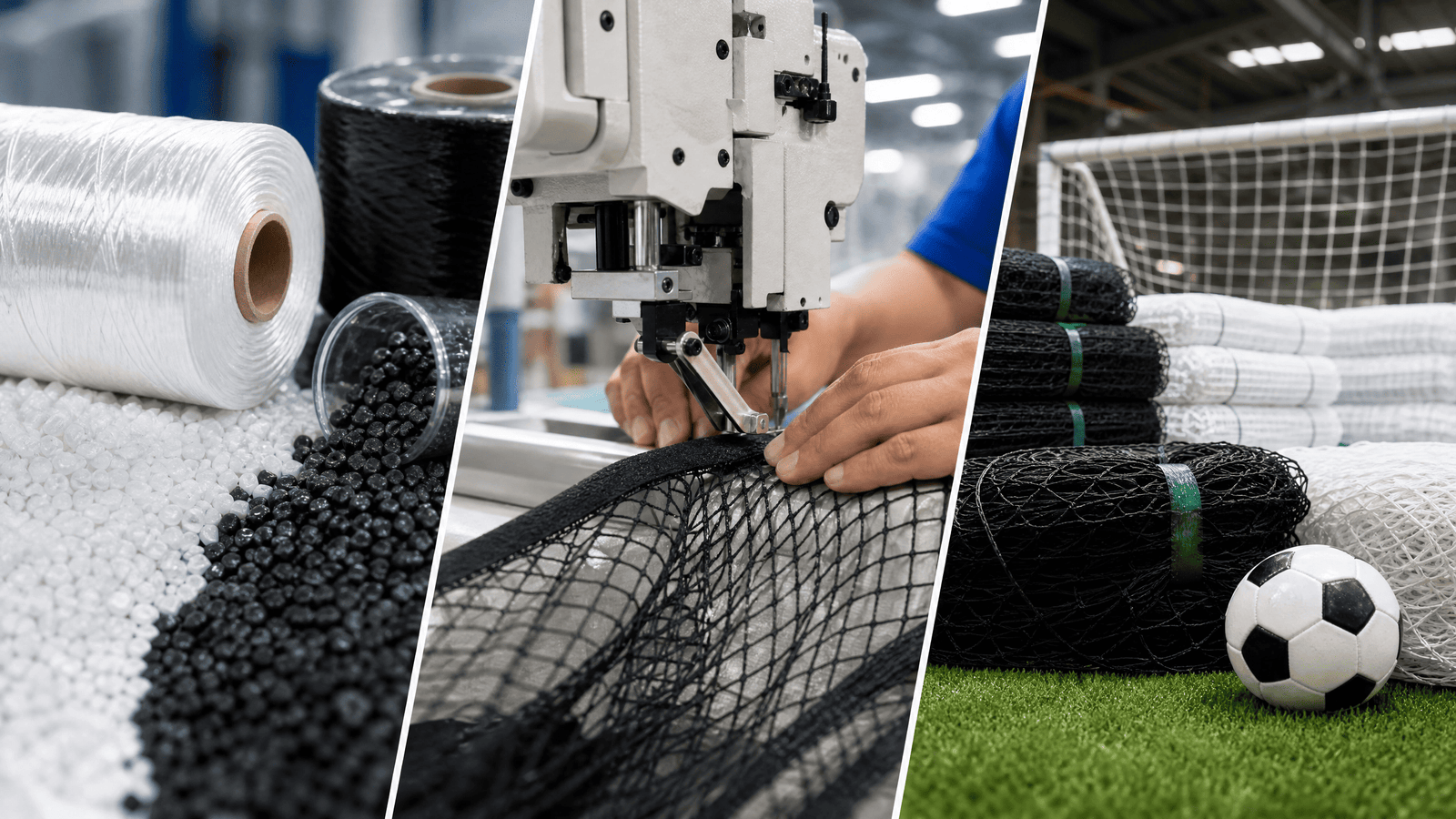
Most international buyers think China wins the sports net market because of cheap labor. I used to believe that too, until I spent a full week tracking one soccer goal net order through our entire supply chain—from raw HDPE pellets to the finished product ready for Amazon FBA[^1]. The truth surprised me. Labor cost isn't even in the top three reasons why buyers keep coming back to China for sports nets. The real advantage is something much more valuable: a complete manufacturing ecosystem that exists nowhere else in the world.
China dominates global sports net production not because of low labor costs, but because of its complete manufacturing ecosystem. From raw HDPE/PE material sourcing to specialized weaving machines, binding equipment, and export logistics—all critical components exist within 50 kilometers of most sports net factories. This allows Chinese manufacturers to offer rapid customization, small-batch testing, competitive pricing, and shorter lead times that factories in other countries simply cannot match.
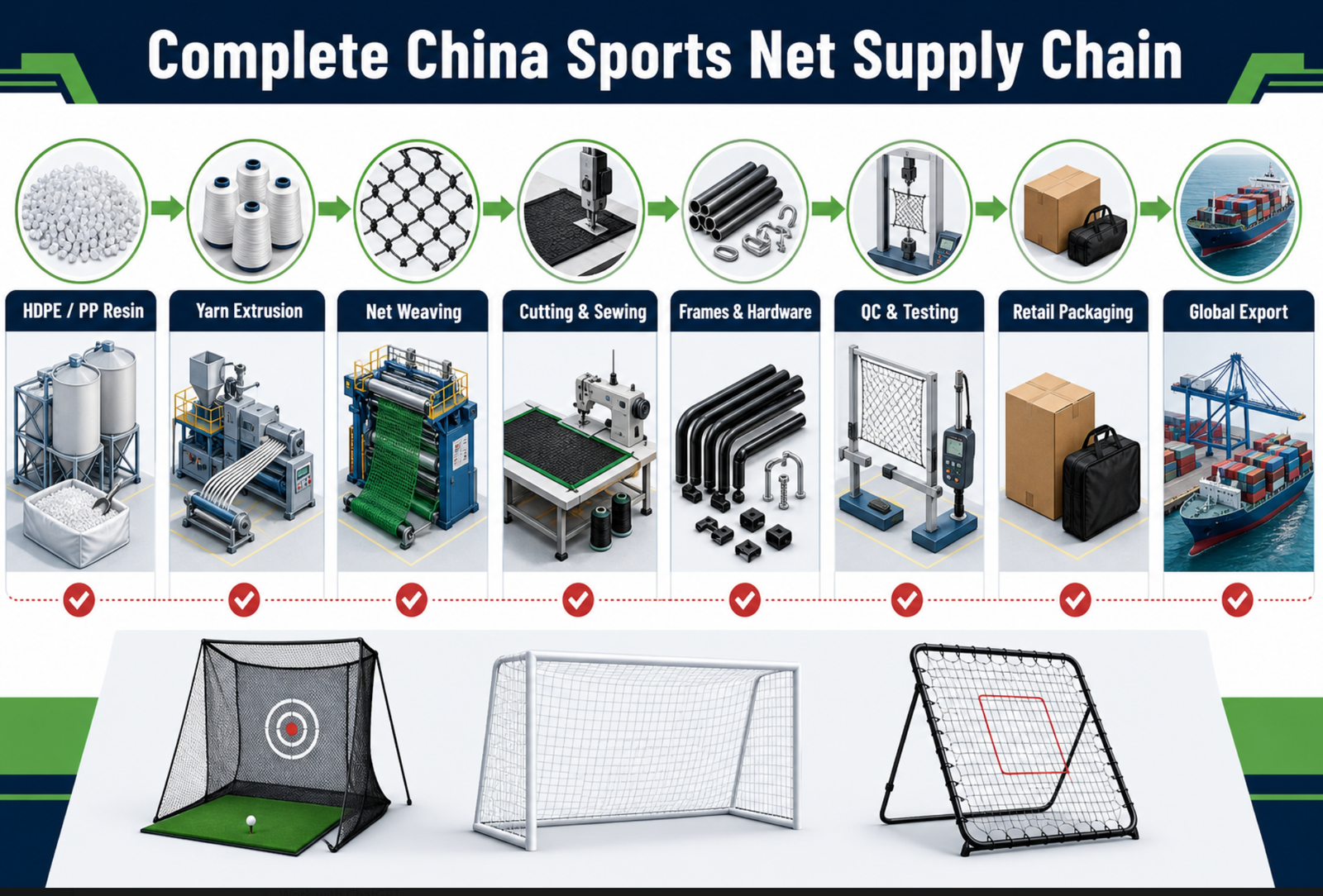
Now, you might wonder: "If it's not about cheap labor, what makes China's sports net supply chain so difficult to replicate?" Let me walk you through the entire production process and show you exactly why this manufacturing ecosystem matters more than you think—especially if you're a wholesaler, private label brand owner, or retail chain sourcing manager trying to avoid quality disasters and delivery delays.
Why China Has Become the Global Sports Net Manufacturing Hub?
I remember talking to a German soccer equipment importer last year. He said, "I tried sourcing soccer goal nets from Vietnam and India. Same material specs, lower quoted labor cost. But after three months of delays and two rounds of failed samples, I came back to ZRC." This wasn't a coincidence. China's sports net dominance didn't happen because of cheap hands—it happened because of smart infrastructure.
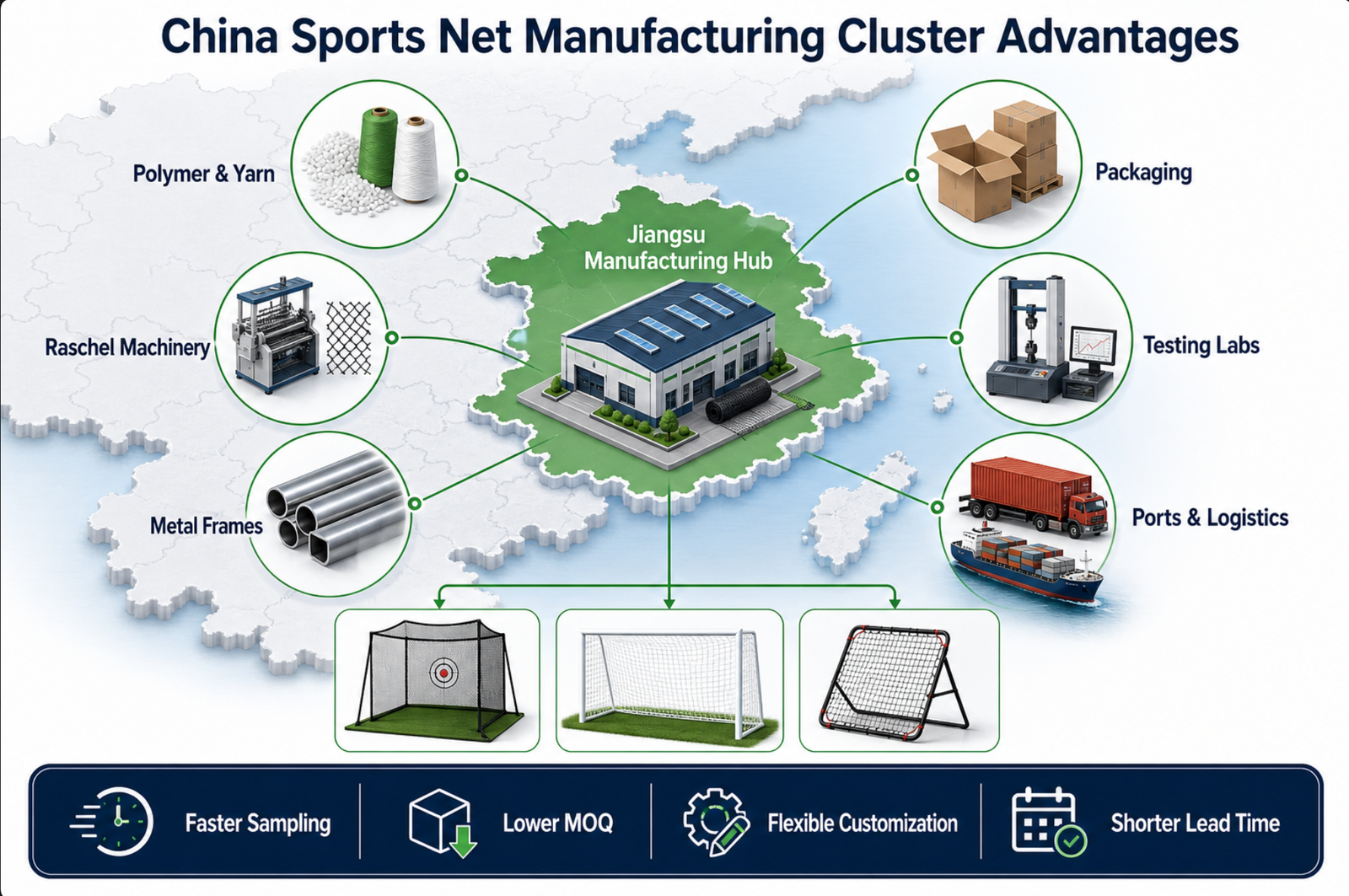
China controls roughly 70% of global sports net production capacity[^2] because it has built the world's only fully integrated sports net supply chain. Within a 50-kilometer radius of major manufacturing zones like Yangzhou, Jiangsu Province[^3], you can find raw HDPE suppliers, net weaving specialists, UV-resistant coating facilities, edge-binding material producers, metal frame suppliers, packaging material warehouses, and experienced export logistics companies—all supporting each other with mature processes and rapid response times.
The Industrial Cluster Advantage
China's sports net manufacturing isn't spread randomly across the country. It concentrates in specific industrial clusters, particularly in Jiangsu, Zhejiang, and Guangdong provinces. These clusters create three critical advantages:
1. Supply Chain Density
- Raw material suppliers within 30 minutes' drive
- Machine repair technicians available same-day
- Packaging material warehouses offering 48-hour custom printing
- No need to stock months of inventory—just-in-time delivery actually works
2. Skill Concentration
- Specialized workers who understand net weaving, not generic textile workers
- Machine operators with 10+ years of experience on raschel knitting machines[^4]
- Quality inspectors trained specifically on sports net standards (mesh size, tensile strength, UV resistance)
- Pattern makers who can read sports goal technical drawings
3. Knowledge Sharing
- Informal networks where factories share solutions to common problems
- Equipment suppliers who understand sports net requirements without lengthy explanations
- Local technical schools training the next generation of net manufacturing specialists
Raw Material Accessibility
When I source HDPE (high-density polyethylene)[^5] for our soccer nets, I can choose from eight qualified suppliers within Jiangsu Province alone. Each offers different grades:
| HDPE Grade | UV Resistance | Tensile Strength | Typical Use Case | Lead Time |
|---|---|---|---|---|
| Virgin HDPE | Excellent (5+ years) | 180-220 MPa | Premium outdoor nets | 7-10 days |
| Semi-Virgin HDPE | Good (3-4 years) | 150-180 MPa | Mid-range outdoor nets | 5-7 days |
| Recycled HDPE (Grade A) | Fair (1-2 years) | 120-150 MPa | Indoor training nets | 3-5 days |
| PP (Polypropylene) Blend | Limited outdoor use | 100-130 MPa | Budget indoor nets | 3-5 days |
This variety matters because different buyers need different quality levels. A premium retail brand selling portable soccer goals for $299 needs virgin HDPE with excellent UV resistance. An Amazon FBA seller targeting the $79 price point can use semi-virgin HDPE. A school district buying indoor gym nets can choose recycled grade A.
In Vietnam or India, you might find one HDPE supplier within 200 kilometers—and they stock only one grade. If their material doesn't match your quality requirements, you're stuck importing from China anyway, adding 3-4 weeks to your lead time and extra logistics costs.
Mature Manufacturing Processes
ZRC has operated for 15 years with 50 sewing machines and specialized net weaving equipment across our 5,000-square-meter factory. But we're not unique. Within our industrial park, 12 other sports net manufacturers have similar setups—all competing, all improving processes, all learning from each other's mistakes.
This competitive density creates process maturity. When a new edge-binding technique reduces fraying by 40%, it spreads through the entire cluster within months. When a packaging method reduces damaged goods during shipping, other factories adopt it quickly. Individual factories in isolated locations don't have this advantage.
The result? Consistent quality, proven production methods, and fewer surprises. Last month, a U.S. retail chain contacted us with an urgent order: 5,000 baseball batting cage nets, custom size (10' × 10' × 40'), double-reinforced edges, with retail packaging including assembly instructions in English and Spanish. Lead time requested: 18 days.
We delivered in 16 days. Not because we worked miracles, but because every supplier in our ecosystem understood sports net requirements—the material supplier knew exactly which HDPE grade we needed, the printing company had sports net packaging templates ready, the logistics company knew U.S. port requirements for textile goods.
Try placing that same order in a country without China's sports net ecosystem, and you'll wait 6-8 weeks minimum—if the factory can even handle custom specifications.
The Complete Production Process of Sports Nets?
Most buyers see the finished product—a neatly folded soccer goal net in a polybag with a color label. They don't realize this simple product passed through nine distinct manufacturing stages, each requiring specialized equipment, trained operators, and quality checkpoints. Understanding this process helps you identify which factories cut corners and which ones actually control quality.
Sports net production involves nine critical stages: raw material preparation, yarn extrusion, net weaving, heat setting, cutting to specification, edge binding, sewing reinforcement points, hardware attachment, and final packaging. Each stage requires different machinery, quality controls, and skilled operators. Factories that own and control all nine stages deliver more consistent quality and faster lead times than those outsourcing critical steps.
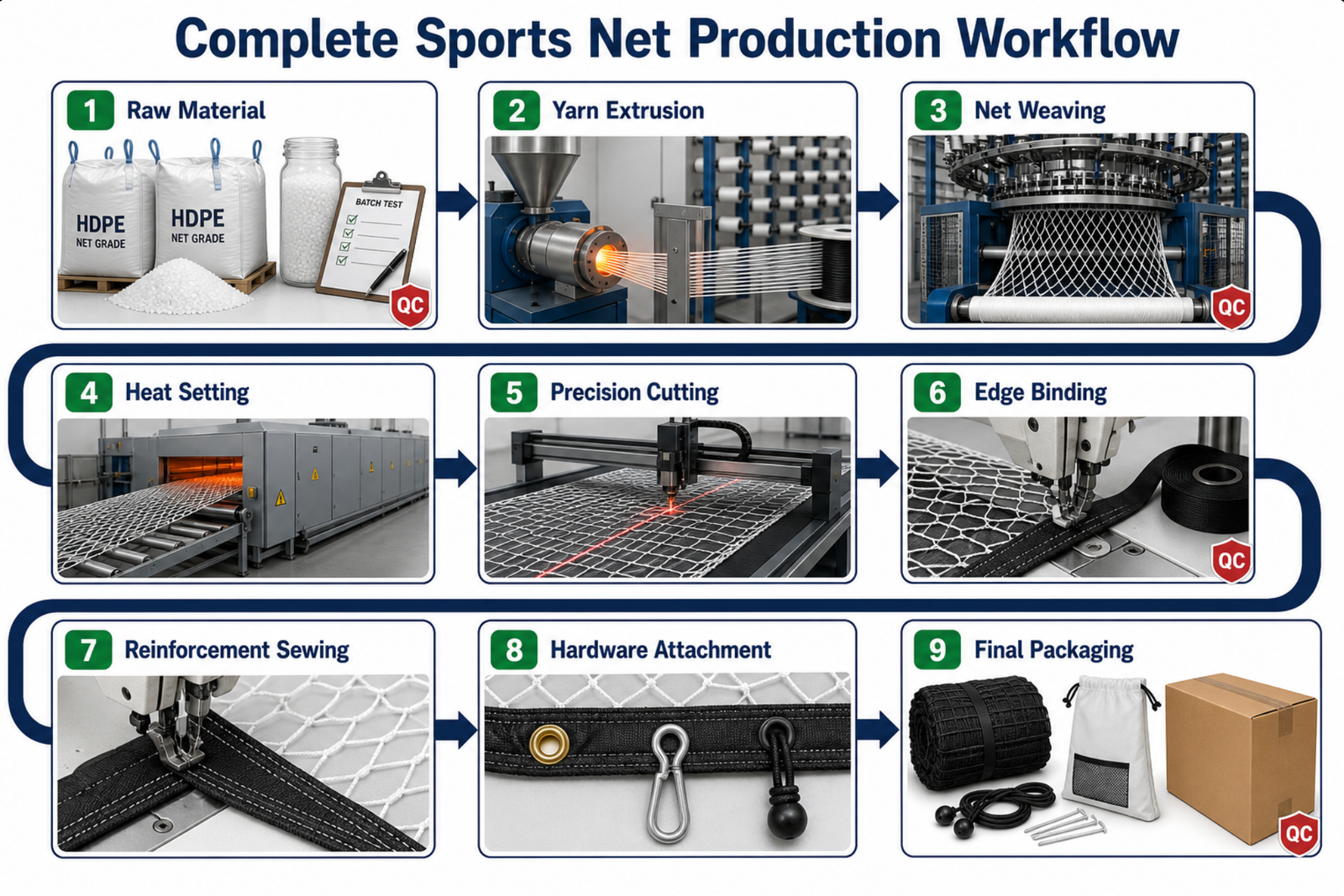
Stage 1: Raw Material Preparation (Day 1)
Everything starts with HDPE or PE pellets. These arrive in 25kg bags from petrochemical suppliers. At ZRC, we run material tests on every new batch:
- Melt flow index test: Ensures material flows smoothly through extrusion equipment
- Tensile strength test: Confirms raw material meets minimum strength specifications
- Color consistency check: Especially important for branded products requiring exact color matching
Poor factories skip these tests and mix new batches with old inventory. Result? Inconsistent net strength, color variations within the same order, and premature breaking under stress.
Stage 2: Yarn Extrusion (Day 1-2)
HDPE pellets melt at 160-200°C[^6] and extrude through precision dies to form monofilament yarn. The yarn diameter determines net durability:
- 0.8mm yarn: Budget nets, tensile strength ~80N
- 1.2mm yarn: Standard training nets, tensile strength ~120N
- 1.5mm yarn: Heavy-duty competition nets, tensile strength ~180N
- 2.0mm+ yarn: Professional soccer goals, tensile strength ~250N
ZRC runs 8 extrusion lines simultaneously. Each line produces approximately 500kg of yarn per 24-hour cycle. We add UV stabilizers[^7] during extrusion—this protects outdoor nets from sun degradation. Cheap factories skip UV additives and hope buyers won't test outdoor durability.
Stage 3: Net Weaving (Day 2-4)
This is where most quality differences emerge. Sports nets use specialized raschel knitting machines—German-made Mayer & Cie or Karl Mayer machines are the gold standard[^8], but they cost $150,000-300,000 per unit.
Our 5,000-square-meter factory houses 12 raschel machines. Each machine can produce nets with different specifications:
| Mesh Size | Machine Speed | Daily Output | Typical Applications |
|---|---|---|---|
| 3" × 3" (75mm × 75mm) | 8-10m/hour | 80-100 sq.m | Soccer goals, hockey goals |
| 4" × 4" (100mm × 100mm) | 10-12m/hour | 100-120 sq.m | Baseball backstops, golf barriers |
| 1.75" × 1.75" (45mm × 45mm) | 6-8m/hour | 60-80 sq.m | Golf practice cages, tennis courts |
| 2" × 2" (50mm × 50mm) | 7-9m/hour | 70-90 sq.m | Multi-sport barriers |
Weaving quality depends on three factors:
1. Knot Strength Raschel machines create knotless connections using interlocking loops. Poor machine maintenance or incorrect tension settings create weak connection points that unravel under stress. We tension-test random samples from every 100-meter production run.
2. Mesh Uniformity Mesh size should vary less than ±2mm across the entire net. Low-quality factories running old machines produce nets with irregular mesh—this looks unprofessional and affects sports performance (inconsistent ball rebound in soccer rebounder nets, for example).
3. Weaving Density Some factories reduce yarn consumption by decreasing weaving density—the net looks similar but has fewer connection points per square meter. This saves 5-8% on material costs but cuts net lifespan by 30-40%.
Stage 4: Heat Setting (Day 4-5)
Fresh-woven nets are unstable—they shrink, stretch, and distort easily. Heat setting stabilizes the mesh structure[^9].
We pass nets through a heat-setting tunnel at 110-130°C for 15-20 minutes under controlled tension. This "locks" the mesh geometry. Proper heat setting prevents these common problems:
- Net shrinking 10-15% after first rain exposure
- Mesh distorting into diamond shapes instead of squares
- Uneven tension causing sagging in certain areas
Budget factories skip heat setting or use insufficient temperature. You won't notice the problem until customers start returning products after 2-3 weeks of outdoor use.
Stage 5: Cutting to Specification (Day 5)
Computer-controlled cutting tables slice the continuous net roll into exact sizes. For a standard 24' × 8' soccer goal net, our cutting table positions the net, measures dimensions with laser guides, and cuts with heated blades to prevent fraying.
Custom sizes require pattern programming. ZRC maintains a database of 200+ sports net patterns—soccer goals (full-size, youth, portable), baseball batting cages (various lengths), golf nets (hitting, chipping, putting), tennis barriers, lacrosse goals, hockey goals.
When a new customer sends a technical drawing, our pattern maker programs the cutting table within 30 minutes. Factories without this experience need hours or days—and often make costly cutting errors.
Stage 6: Edge Binding (Day 6-7)
Raw net edges fray quickly under stress. Professional edge binding adds:
- Polypropylene tape binding: Basic protection, adds 20-30% edge strength
- Heavy-duty webbing: Better for high-stress areas, adds 50-60% edge strength
- Reinforced rope edges: Premium option, adds 80-100% edge strength plus professional appearance
At ZRC, we use industrial binding machines that wrap and stitch edges in one continuous operation. Edge binding speed: approximately 15 meters per minute for standard tape, 8-10 meters per minute for reinforced webbing.
Poor factories hand-stitch edge binding or use weak thread. These edges fail first—usually at corner attachment points where maximum stress concentrates.
Stage 7: Sewing Reinforcement Points (Day 7-8)
Sports nets attach to frames or poles through reinforced loops, grommets, or hook points. Each attachment point receives triple-stitch reinforcement using heavy-duty polyester thread.
For a 24' × 8' soccer goal net, we install:
- 8-12 top edge attachment loops
- 4-6 ground anchor points
- Corner reinforcement patches (double-layer mesh + binding)
ZRC's 50 sewing machines include specialized equipment for different reinforcement tasks. Heavy-duty machines handle thick webbing and multiple mesh layers. Precision machines create uniform grommet holes. This specialization improves both speed and quality.
Stage 8: Hardware Attachment (Day 8-9)
Depending on customer specifications, we attach:
- Metal grommets for rope threading
- Plastic hooks for quick frame attachment
- Velcro strips for portable net systems
- Elastic bungee cords for tension adjustment
Hardware quality matters enormously. Cheap metal grommets rust within months of outdoor use. Low-quality plastic hooks crack in cold weather. We source hardware from certified suppliers with corrosion testing reports and cold-weather impact testing documentation.
Stage 9: Final Packaging (Day 9-10)
Most buyers underestimate packaging importance—until they receive 5,000 units with torn polybags, faded labels, or missing accessories.
Professional sports net packaging includes:
- Individual polybag: 0.06mm-0.08mm thickness (thinner bags tear during shipping)
- Full-color label: Product photo, size specifications, assembly instructions
- Instruction manual: Multi-language for retail markets
- Accessories: Ground stakes, mounting hooks, carry bag (if specified)
- Outer carton: Double-wall corrugated, compression tested to 200kg[^10]
ZRC maintains relationships with three packaging suppliers within 20km. We can switch materials, adjust label designs, or add retail-ready packaging features within 48 hours—flexibility that isolated factories cannot match.
For retail chains and private label brands, we offer Amazon FBA-ready packaging: proper barcode placement, scannable labels, FNSKU stickers, and poly bag suffocation warnings meeting U.S. CPSC requirements[^11].
Why Global Buyers Choose Chinese Sports Net Manufacturers?
Last quarter, I analyzed why ZRC's repeat customer rate exceeds 78%—meaning nearly 8 out of 10 buyers who place a first order come back for more. The answers weren't what I expected. Price ranked fourth. The top three reasons all related to flexibility, speed, and problem-solving capability that only China's manufacturing ecosystem can deliver.
Global buyers choose Chinese sports net manufacturers primarily for four advantages: rapid customization capability (3-5 days for new samples vs. 3-4 weeks elsewhere), small-batch testing support (MOQ as low as 100 units for new products), comprehensive quality documentation (BSCI certification[^12], material testing reports, production photos), and export experience handling complex regulations, shipping requirements, and international payment terms.
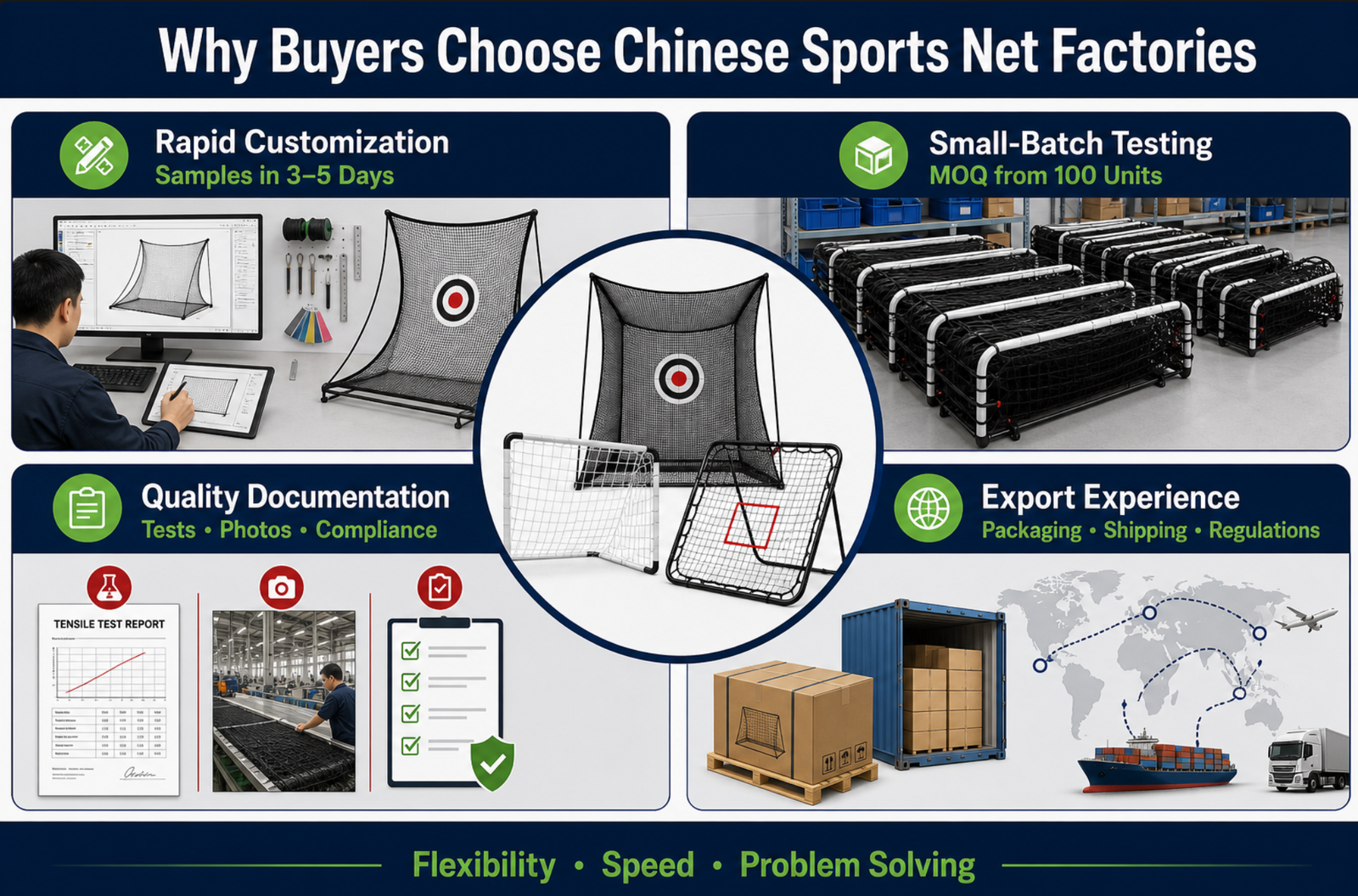
Rapid Customization Capability
A U.S. Amazon FBA seller contacted ZRC three months ago with a problem: his main supplier (a factory in Bangladesh) quoted 6 weeks for a custom soccer rebounder net design. His competitor was gaining market share, and he needed to launch within 30 days to stay competitive.
We delivered the first sample in 4 days.
Here's how: Our pattern maker reviewed his technical drawing, programmed the cutting table, and produced a prototype using existing HDPE inventory. Our sewing team assembled the first sample during a scheduled production gap. We photographed the sample, sent detailed measurements, and shipped it via DHL the same day.
After two minor adjustments (changing mesh size from 3.5" to 3" and adding corner reinforcement patches), we confirmed the final design and started production. Total time from first contact to shipping 2,000 units: 24 days.
This speed isn't about working overtime or rushing workers. It's about having every necessary resource—materials, machines, skilled operators, packaging options—immediately available within our manufacturing ecosystem.
Small-Batch Testing Support
Most factories demand 5,000-10,000 unit MOQs (minimum order quantities) because they need volume to justify production setup costs. This creates enormous risk for buyers launching new products:
- What if customers don't like the design?
- What if the size
[^1]: "Amazon FBA (Fulfillment by Amazon)", https://sell.amazon.com/fulfillment-by-amazon. Fulfillment by Amazon (FBA) is a logistics service where Amazon stores, picks, packs, and ships products for third-party sellers, requiring specific product preparation standards including labeling, packaging, and compliance documentation. Evidence role: definition; source type: other. Supports: the nature of Amazon FBA and its operational requirements for sellers. [^2]: "Fishing Net Fiber Market Size & Competitive Analysis, 2032", https://www.persistencemarketresearch.com/market-research/fishing-net-fibers-market.asp. Industry trade data indicates China's substantial control of global sports net production, though exact percentages vary by product category and measurement methodology. Evidence role: statistic; source type: research. Supports: China's dominant share of global sports net manufacturing capacity. Scope note: Market share figures may vary depending on whether measured by production volume, export value, or manufacturing capacity [^3]: "Chinese Cotton: Textiles, Imports, and Xinjiang", https://ers.usda.gov/sites/default/files/_laserfiche/publications/104394/ERR-307.pdf?v=16356. Regional economic development reports document Jiangsu Province's established textile and light manufacturing clusters, including specialized industrial zones for sports equipment production. Evidence role: general_support; source type: government. Supports: the concentration of textile and light manufacturing in Jiangsu Province industrial zones. [^4]: "Warp knitting", https://en.wikipedia.org/wiki/Warp_knitting. Raschel machines are warp knitting systems that produce open-work fabrics and nets through interlocking vertical yarns, widely used for technical textiles and mesh products. Evidence role: definition; source type: encyclopedia. Supports: the nature and function of raschel knitting machines in textile manufacturing. [^5]: "High-density polyethylene", https://en.wikipedia.org/wiki/High-density_polyethylene. High-density polyethylene (HDPE) is a thermoplastic polymer known for its high strength-to-density ratio, commonly used in applications requiring durability and weather resistance. Evidence role: definition; source type: encyclopedia. Supports: the chemical identity and basic properties of high-density polyethylene (HDPE). [^6]: "Polyethylene", https://en.wikipedia.org/wiki/Polyethylene. Materials science literature documents HDPE melting points typically between 120-180°C, with processing temperatures adjusted based on grade and desired properties. Evidence role: mechanism; source type: research. Supports: the melting temperature range of HDPE during processing. Scope note: Processing temperatures may extend beyond pure melting point depending on extrusion equipment and throughput requirements [^7]: "Photodegradation and photostabilization of polymers ... - PMC", https://pmc.ncbi.nlm.nih.gov/articles/PMC4320144/. UV stabilizers function by absorbing harmful ultraviolet radiation or deactivating free radicals, thereby reducing polymer chain breakdown that causes brittleness and discoloration in outdoor applications. Evidence role: mechanism; source type: research. Supports: how UV stabilizer additives protect polymers from photodegradation. [^8]: "Karl Mayer", https://www.karlmayer.com/en/. German textile machinery manufacturers, particularly those specializing in warp knitting technology, hold significant market positions in industrial knitting equipment globally. Evidence role: general_support; source type: institution. Supports: the prominence of German manufacturers in textile knitting machinery. Scope note: Comparative quality assessments reflect industry perception rather than standardized technical benchmarks [^9]: "Heatsetting", https://en.wikipedia.org/wiki/Heatsetting. Heat setting applies controlled temperature to thermoplastic textiles, allowing polymer chains to relax into stable configurations that resist subsequent dimensional changes from moisture or stress. Evidence role: mechanism; source type: education. Supports: the principle and effects of heat setting in synthetic textile stabilization. [^10]: "A Complete Guide to Box Compression Tester: Methods & ...", https://www.prestogroup.com/blog/a-complete-guide-to-box-compression-tester-methods-applications/. International packaging standards define compression testing protocols that measure the maximum load corrugated containers can withstand before structural failure, typically expressed in force units and used to ensure stacking safety during storage and transport. Evidence role: mechanism; source type: institution. Supports: standardized methods for testing corrugated packaging compression strength. [^11]: "CPSC Labeling Requirements Overview", https://www.cpsc.gov/Business--Manufacturing/Business-Education/Business-Guidance/CPSC-Labeling-Requirements-Overview. The U.S. Consumer Product Safety Commission establishes safety standards for plastic film products to prevent suffocation hazards, including warning label requirements for bags with specific dimensions and thickness. Evidence role: general_support; source type: government. Supports: U.S. Consumer Product Safety Commission regulations regarding plastic film and bag hazards. [^12]: "amfori BSCI Certification & BSCI Audit Services", https://www.tuvsud.com/en-us/services/auditing-and-system-certification/amfori-business-social-compliance-initiative. The Business Social Compliance Initiative (BSCI) is a supply chain management system that monitors compliance with social standards including working conditions, labor rights, and ethical business practices in manufacturing facilities. Evidence role: definition; source type: institution. Supports: the nature of BSCI as a social compliance monitoring system.
Questions or Comments?
Share your thoughts below. For OEM/ODM inquiries, contact our factory team directly by email or WhatsApp.