OEM Sports Nets: What Importers Need to Know Before Ordering
Sourcing OEM sports nets looks straightforward until the first shipment arrives. The net gauge is wrong, the carry bag is missing, and the retail box doesn't fit the Amazon FBA pallet. Problems like these rarely trace back to price — they trace back to an incomplete specification agreed too early. This article gives importers, sourcing agents, and private-label brands a practical framework for getting OEM and ODM sports net orders right before production starts.
The safest way to source OEM sports nets is to fix the full product specification — dimensions, frame material, net polymer, yarn diameter, mesh size, binding, accessories, branding, and packaging — before requesting or comparing any quote. A price comparison is only meaningful when every supplier is quoting the identical product[^1]. Importers who skip this step routinely receive the cheapest quote and the highest-risk shipment.
Locking the specification first sounds obvious. In practice, most sourcing problems start because buyers send an incomplete brief and suppliers fill the gaps with whatever material is in stock. The sections below walk through each decision point in the order it matters.
Which sports net specifications should importers define before requesting a quote?
Undefined specifications are the single biggest driver of sample rejections, production delays, and post-shipment disputes. Yet most initial inquiries list only an overall size and a target price.
A complete specification removes supplier assumptions and makes every quote comparable. Before you send an RFQ for golf practice nets, soccer goals, or rebound nets, every field in the table below should be either locked or flagged as buyer must specify.
| Specification Field | Why It Matters | Action Required |
|---|---|---|
| Overall product dimensions | Affects material yield, frame length, and packaging size | Buyer must specify |
| Frame / tube material | Steel, fiberglass, or composite behave differently in outdoor use[^2] | Buyer must specify |
| Frame / tube diameter and wall thickness | Determines rigidity and shipping weight | Confirm with factory |
| Net polymer type | Polyester, polyethylene, and nylon differ in UV and abrasion resistance[^3] | Buyer must specify |
| Yarn diameter | Affects net strength, weight, and feel | Buyer must specify or confirm with factory |
| Mesh aperture size | Determines ball retention and product category fit | Buyer must specify |
| Number of net plies or knotted/knotless construction | Affects durability and production cost | Buyer must specify |
| Edge binding type and width | High-stress corners need reinforced binding | Confirm with factory |
| Stitching pattern and stitch density at reinforcement points | Weak stitching is a leading cause of field returns[^4] | Confirm with factory |
| Color (Pantone reference) | Prevents dye-batch variation across production runs | Buyer must specify |
| Logo placement, size, and print method | Embroidery, heat transfer, and screen print have different durability profiles[^5] | Buyer must supply artwork files |
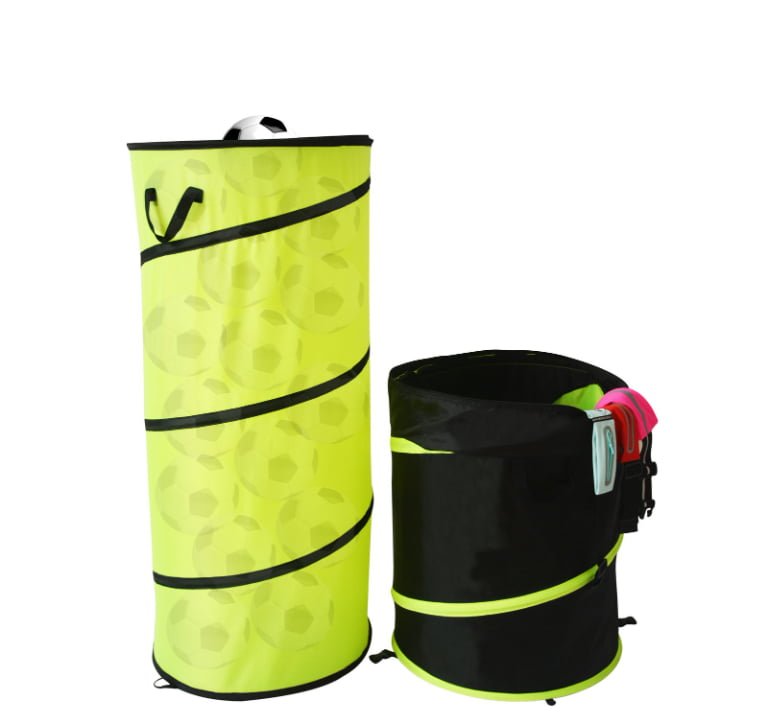
| Carry bag, stakes, ropes, connectors, and accessory bundle | Missing accessories generate negative reviews | Buyer must specify full BOM |
| Retail packaging type | Retail box, poly bag, and FBA carton have different structural requirements | Buyer must specify |
| Barcode, labeling, and language requirements | Vary by retail channel and target country | Buyer must supply files |
| Instruction sheet language and content | Some markets require local language legally[^6] | Buyer must supply or approve |
Why defining specifications upfront protects your margin
The cost of a revision compounds quickly. A net polymer substitution discovered after production approval can require a full re-run. A carry bag omitted from the BOM forces an air-freight top-up shipment[^7]. A Pantone mismatch on a retail box delays FBA check-in.
I have seen importers lose an entire selling season because the golden sample was approved on dimensions alone and the production run used a lighter yarn than the sample. There was no written tolerance on yarn diameter, so the factory was technically correct and the buyer had no recourse.
Three practical rules protect you:
- Define the bill of materials (BOM) completely, including every accessory, its material, and its quantity per set.
- Write numeric tolerances for every dimension and for critical material parameters. Ask the factory what tolerance is achievable and document the agreed range.
- Keep the approved sample physically or as a documented golden sample with a signed specification sheet. This becomes the reference during QC.
How do MOQ, sampling, and lead times change for OEM and ODM orders?
Standard catalog products and fully customized OEM structures operate on very different timelines and minimum quantities. Importers who apply catalog assumptions to ODM projects consistently underprice development time and over-promise launch dates to their retail buyers.
MOQ, sampling timelines, and production lead times are conditional. They depend on customization depth, tooling requirements, material sourcing, color count, and SKU mix. The figures below are working ranges based on ZRC's current operations as of August 2026 — treat them as planning estimates and confirm the exact schedule for your project before committing to downstream deadlines.
Minimum order quantities
MOQ is not a single number. It is a function of how much the product deviates from an existing production setup.
- Standard or lightly modified products (minor size change, logo addition, color swap on existing tooling): MOQ commonly starts around 50–100 units per style.
- Customized structures or retail-packaging programs (new frame dimensions, new accessory bundle, branded retail box with new dieline): MOQ commonly starts around 200 units per SKU.
- Mixed-SKU production is sometimes possible. Ask the factory explicitly whether multiple SKUs in one production run can share a combined MOQ. This is particularly relevant for importers launching a range of sizes or styles simultaneously.
Final MOQ always depends on tooling amortization, minimum material roll quantities, color and print setup, and packaging print economics. Never assume the MOQ from a catalog product applies to your OEM version.
Sampling timelines
| Sample Type | Typical Timeline | Conditions |
|---|---|---|
| Simple modification (logo, color, minor dimension) | 7–14 days | Existing frame tooling, in-stock base material |
| New ODM development (new structure, new frame design) | 2–4 weeks | New tooling, sourcing, or construction method required |
| Practical target for many projects | 10–15 days | Subject to complexity confirmation with factory |
Sampling timelines start from the date all files and decisions are confirmed — not from the inquiry date. Delays in supplying logo files, Pantone references, or dieline artwork directly extend the sample timeline.
Production lead times
| Order Type | Indicative Lead Time | Conditions |
|---|---|---|
| Standard repeat order (approved spec, in-stock materials) | 15–25 business days | No new tooling, no new materials |
| New OEM/ODM project (first production run) | ~35–50 days from confirmed requirements | Includes pre-production approval steps |
These are not guarantees. Buffer your critical path by at least two weeks for documentation, pre-shipment inspection, and booking logistics. New retail-packaging programs may add time for packaging proofing and approval.
How can buyers verify production consistency, QC, packaging, and export readiness?
A factory's ability to quote your specification is not the same as its ability to hold that specification across 5,000 units. Production consistency is verified through checkpoints, not promises.
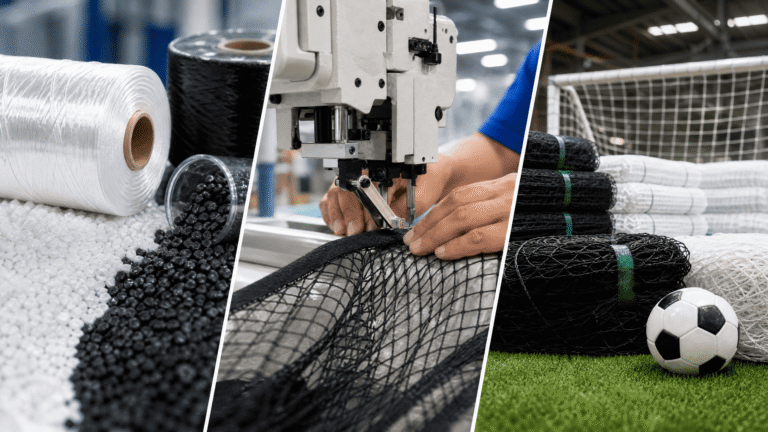
ZRC operates 3 production lines with 50+ sewing machines and a monthly capacity above 150,000 units, built across more than 15 years of sports net manufacturing since 2011. That context matters — but buyers should ask for evidence at each stage, not rely on stated capacity alone.
QC checkpoints importers should request
A credible OEM factory applies quality checks at multiple stages, not just at final inspection. Ask for the factory's QC procedure and confirm it covers:
Incoming materials
- Net yarn and polymer verification
- Frame and tube dimensional check
- Hardware and accessory batch check
In-process production
- Cutting accuracy and consistency
- Stitching density and pattern conformity
- Mesh uniformity across the net panel
- Edge binding width and attachment security
- Reinforcement stitching at high-stress points (corners, attachment rings)
- Needle break and needle safety protocol[^8]
Final product
- Overall dimension check against golden sample
- Frame and accessory matching and completeness
- Labeling and barcode scan accuracy
- Packaging integrity and drop-test suitability
Pre-shipment
- Carton count and weight verification
- FBA labeling conformity if applicable
- Photo or video evidence of packed goods
Packaging and export readiness
Retail-channel buyers and FBA sellers have packaging requirements that go beyond product protection. Specify the following in writing before production:
- Retail box construction, print finish, and insert design
- Barcode format and placement
- Language requirements for instructions and labeling
- Carton master dimensions and weight for freight calculation
- FBA poly-bag and suffocation-warning label requirements if applicable[^9]
Packaging failures — crushed corners, missing barcodes, incorrect language — cause receiving rejections and returns[^10]. Treat packaging as part of the product specification, not an afterthought.
A note on compliance documentation
Requirements vary by target market and retail channel. Do not assume any documentation set is universal. Ask the factory for current, scope-matched documentation relevant to your destination market and intended retail channel, then have your own compliance team or a qualified third party assess sufficiency.
What should a complete RFQ include for golf nets, soccer goals, and rebound nets?
An RFQ that generates a comparable, actionable quote is not a product name and a price target. It is a structured document that removes every assumption a supplier might otherwise make.
RFQ checklist for OEM sports nets
- [ ] Product category and use case — golf chipping net, soccer rebounder, batting cage, etc.; indoor or outdoor; user age group
- [ ] Target market and destination country — affects labeling language, compliance documentation requirements, and packaging standards
- [ ] Sales channel — retail shelf, Amazon FBA, distributor, or sports club supply
- [ ] Full dimensional specification — overall size, frame length segments, net panel dimensions
- [ ] Bill of materials — every component: frame, net, carry bag, stakes, ropes, connectors, retail box, instruction sheet
- [ ] Material specifications — frame material and tube spec; net polymer, yarn diameter, mesh aperture, construction type
- [ ] Color specifications — Pantone references for net, frame, and packaging
- [ ] Logo and branding files — vector artwork, print method, placement diagram
- [ ] Packaging dieline or reference — retail box dieline, FBA carton spec, poly-bag requirement
- [ ] Barcode and labeling files — EAN/UPC, retailer-specific label requirements
- [ ] Instruction sheet content — language, content, format
- [ ] Target quantity and SKU mix — units per style; ask about mixed-SKU options
- [ ] Required sample timeline — your hard deadline for sample approval
- [ ] Required production delivery window — ex-factory date or destination arrival
- [ ] QC and inspection requirements — in-process checkpoints, pre-shipment inspection, documentation requests
- [ ] Compliance documentation needed — specify destination market; ask for current, scope-matched documentation
Buyer decision framework summary
| Decision Stage | Key Action | Risk if Skipped |
|---|---|---|
| 1. Define use case and market | Specify indoor/outdoor, age group, channel, destination | Specification gaps filled by supplier assumptions |
| 2. Lock technical specification | Complete all fields in the spec table before quoting | Incomparable quotes; wrong material at production |
| 3. Supply all files upfront | Logo, Pantone, dieline, barcode, instruction content | Sample delays; production hold for missing assets |
| 4. Approve golden sample with tolerances | Signed sample + written tolerances + QC checklist | No enforceable reference for production conformity |
| 5. Confirm MOQ per SKU | Ask about customization level and mixed-SKU options | Incorrect minimum commitment; tooling cost surprises |
| 6. Confirm all timelines in writing | Sample, production, packaging proof, pre-shipment | Launch delay; missed retail window |
| 7. Evaluate total landed risk | Compare consistency, accessories, packaging, lead time | Lowest unit price becomes highest total cost |
Frequently Asked Questions
What is the difference between OEM and ODM for sports nets?
OEM means you supply the complete design and specification; the factory manufactures to your blueprint. ODM means the factory contributes design capability[^11] — you may modify an existing structure or co-develop a new one. ODM typically requires more development time and may have higher MOQ or tooling costs than a straightforward OEM run.
Can importers mix multiple SKUs to meet MOQ requirements?
Sometimes. Mixed-SKU production is possible for some projects, particularly where SKUs share the same frame tooling, net material, and production setup. Ask the factory explicitly and confirm whether the mixed MOQ applies per production run or per individual style. Final terms depend on customization depth and scheduling.
How long does OEM sports net sampling typically take?
As of August 2026, simple modifications commonly take 7–14 days; new ODM development may take 2–4 weeks. A practical working target for many projects is 10–15 days, subject to complexity. Timelines begin when all specification files and decisions are confirmed — not from initial inquiry.
What documentation should importers request for their target market?
This depends entirely on the destination country, retail channel, and end-user age group. There is no universal documentation set. Ask the factory for current, scope-matched documentation relevant to your market and channel, and have your compliance team or a qualified third party evaluate whether it meets your requirements.
What causes most post-shipment complaints for sports nets?
Based on common market patterns, the most frequent complaints involve torn net panels at reinforcement points, broken or bent frame sections, missing accessories such as carry bags or stakes[^12], incorrect or unreadable assembly instructions, and packaging damage. Most of these failures are preventable through complete BOM specification, written stitching and binding requirements, and structured pre-shipment inspection.
Is retail-ready or Amazon FBA packaging available for OEM orders?
Yes. Retail box design, FBA-compliant poly-bag labeling, barcode application, and multi-language instruction sheets can all be included in a packaging specification. These requirements must be defined in writing before production begins, as packaging proofing and approval add time to the first-run schedule.
How should importers evaluate two quotes with different unit prices?
Compare the full landed risk, not the unit price. Confirm that both quotes reference the identical specification, the same accessories and BOM, the same packaging standard, and the same inspection commitments. A lower unit price achieved through lighter yarn, omitted accessories, or a thinner retail box is not a comparable quote.
Conclusion
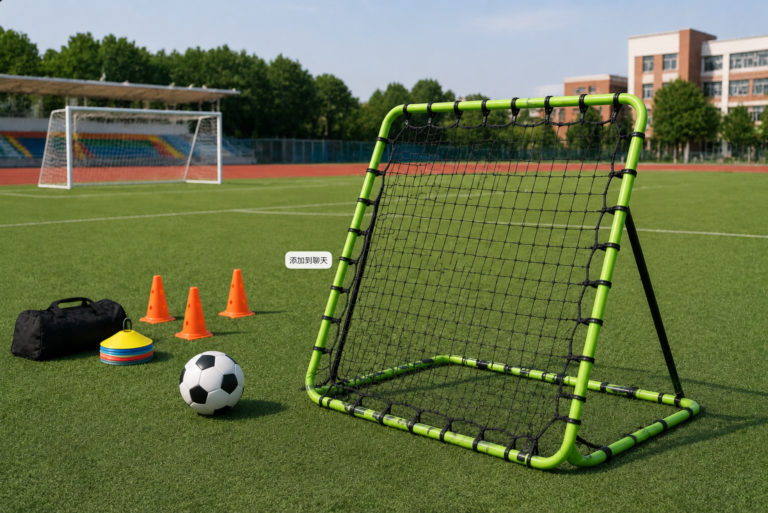
OEM sports nets — whether golf practice nets, soccer goals, or rebound trainers — are not commodity items. Every dimension, material choice, accessory, and packaging decision affects field performance, retail presentation, and review scores. Importers who define the complete specification before requesting quotes compare real options. Those who compare incomplete quotes first spend that saved time managing production revisions, sample rejections, and post-shipment disputes.
The practical takeaway: fix the specification, supply all files, approve a golden sample with written tolerances, and evaluate total landed risk rather than unit price alone. That sequence consistently produces better outcomes than chasing the lowest number on an incomplete brief.
ZRC has manufactured OEM and ODM sports training nets since 2011, with 3 production lines, 50+ sewing machines, and monthly capacity above 150,000 units. If you are preparing an RFQ for golf nets, soccer goals, or rebound nets, contact us with your specification requirements and we will help you identify what needs to be confirmed before we quote.
[^1]: "Advanced Procurement - Analyzing Costs Using Total Cost of Ownership", https://psep.smeal.psu.edu/short-courses/supply-chain-accelerator/advanced-procurement-analyzing-costs-using-total-cost-of-ownership. Supply chain management and procurement textbooks consistently identify specification completeness and uniformity as a prerequisite for valid competitive bidding, noting that price comparisons across non-equivalent specifications distort cost analysis and increase total landed risk. Evidence role: expert_consensus; source type: education. Supports: The procurement principle that meaningful competitive bidding requires all suppliers to quote against an identical, fully defined specification. Scope note: Academic procurement literature addresses this principle at a general level; direct empirical studies quantifying the cost impact specifically in OEM sports goods sourcing are not available. [^2]: "Pultruded Fiberglass vs. Carbon Fiber: Which Is Right for Your Project?", https://www.tencom.com/blog/pultruded-fiberglass-vs.-carbon-fiber-which-is-right-for-your-project?hs_amp=true. Materials science literature documents meaningful differences among steel, fiberglass, and fiber-reinforced composite materials in corrosion resistance, flexural strength, weight-to-strength ratio, and long-term outdoor durability, properties that directly influence suitability for load-bearing outdoor equipment frames. Evidence role: mechanism; source type: research. Supports: Comparative mechanical and environmental performance characteristics of steel, fiberglass, and composite materials in outdoor structural applications. Scope note: Performance outcomes depend heavily on alloy grade, fiber orientation, resin type, and coating; general material comparisons should be supplemented by supplier-specific test data for the exact grades quoted. [^3]: "Thermal oxidation, ultraviolet radiation, and mechanical ... - PMC", https://pmc.ncbi.nlm.nih.gov/articles/PMC12992378/. Studies on polymer weathering have documented differential UV degradation rates and abrasion resistance among common synthetic fibers, including polyester, polyethylene, and nylon, with performance outcomes varying by exposure conditions and fiber construction. Evidence role: mechanism; source type: research. Supports: Comparative UV degradation and abrasion resistance characteristics of polyester, polyethylene, and nylon polymers. Scope note: General polymer literature may not address sports net geometries specifically; findings from textile or geotextile research should be interpreted with awareness of application differences. [^4]: "The Specific Consumer Expectations Test for Product Defects", https://www.repository.law.indiana.edu/cgi/viewcontent.cgi?article. Research on textile product failure modes has identified seam integrity—including stitch density, thread tensile strength, and reinforcement at high-stress junctions—as a principal determinant of product lifespan and a documented source of field failures in load-bearing textile applications. Evidence role: general_support; source type: research. Supports: Seam and stitching failures as a significant contributor to product returns or field failures in outdoor textile and sports equipment. Scope note: Direct consumer return data specific to sports nets is not publicly available; evidence from broader textile engineering literature is cited as a proxy. [^5]: "The Impact of Routine Laundering on Ultraviolet Protection Factor (UPF ...", https://pmc.ncbi.nlm.nih.gov/articles/PMC10440054/. Research on textile decoration methods has examined wash fastness, abrasion resistance, and UV stability across embroidery, heat-transfer, and screen-print applications, with durability outcomes shown to depend on substrate type, ink or thread composition, and environmental exposure. Evidence role: mechanism; source type: research. Supports: Relative durability of embroidery, heat transfer, and screen printing decoration methods on textile substrates under outdoor or mechanical stress conditions. Scope note: Published studies focus predominantly on apparel substrates; direct evidence for sports net mesh materials is limited and findings should be applied with caution. [^6]: "Basic Importing and Exporting", https://www.cbp.gov/trade/basic-import-export. European Union product safety and general product labeling regulations require that instructions and safety information be provided in the official language(s) of the member state where a product is placed on the market, a requirement that extends to imported consumer goods. Evidence role: general_support; source type: government. Supports: Legal requirements in certain jurisdictions mandating consumer product instructions or labeling in the local language of the destination market. Scope note: Specific language obligations vary by product category, regulation, and jurisdiction; this citation supports the general principle but does not constitute legal advice applicable to all markets mentioned in the article. [^7]: "Air Freight vs Sea Freight: Cost, Shipping, Carbon Footprint & More", https://www.freightos.com/freight-resources/air-freight-vs-ocean-freight-making-the-decision/. International freight rate data from logistics institutions and trade bodies consistently show air freight costs per kilogram exceeding ocean freight costs by a substantial multiple, making unplanned air-freight corrections for missing components a disproportionately expensive outcome of procurement errors. Evidence role: general_support; source type: institution. Supports: The significant cost premium of air freight relative to sea freight, which makes unplanned supplementary air shipments a material financial consequence of specification errors. Scope note: Exact cost multiples fluctuate with fuel prices, route, and market conditions; figures should be verified against current freight indices at the time of use. [^8]: "(PDF) Product Safety Practice NEEDLE AND METAL ...", https://www.academia.edu/22675370/Product_Safety_Practice_NEEDLE_AND_METAL_CONTAMINATION_CONTROL_STANDARD_OPERATING_PROCEDURES. Industry codes of practice and retail compliance standards for sewn goods manufacturing, including programs administered by major apparel and sporting goods retailers, specify needle control policies requiring documentation of needle breakage, retrieval of all fragments, and inspection confirmation before products proceed to packaging. Evidence role: general_support; source type: institution. Supports: Needle break detection and control protocols as an established quality and safety requirement in textile and sewn-goods manufacturing. Scope note: Mandatory requirements vary by retail buyer program and destination market; some programs require third-party audit verification while others rely on factory self-declaration. [^9]: "Bagging requirements", https://sellercentral.amazon.com/help/hub/reference/external/G201685210?locale=en-US. Amazon's published FBA packaging and preparation requirements specify that poly bags with an opening of 5 inches or greater must display a suffocation warning label or printed warning visible on the outside of the bag, a requirement applicable to products shipped to Amazon fulfillment centers for retail sale. Evidence role: general_support; source type: other. Supports: Amazon FBA program requirements for suffocation warning labels on poly-bag packaging above specified opening dimensions. Scope note: Amazon FBA requirements are updated periodically; the requirement described reflects published policy as of the article's writing and should be verified against current Amazon Seller Central documentation before production. [^10]: "Why Amazon Rejects FBA Shipments (And How to Fix It)", https://texaslogisticservices.com/blog/common-reasons-amazon-rejects-fba-shipments/. Amazon's published FBA preparation and labeling requirements specify that items failing to meet packaging, barcode, and labeling standards may be refused, relabeled at the seller's expense, or returned, practices that parallel receiving standards documented by major retail distribution programs. Evidence role: general_support; source type: other. Supports: That retail and fulfillment center receiving processes reject shipments for packaging deficiencies including structural damage, absent or unreadable barcodes, and non-compliant labeling. Scope note: Specific rejection criteria vary by retailer and fulfillment network; Amazon FBA policies are periodically updated and should be verified directly with current program documentation. [^11]: "Original equipment manufacturer", https://en.wikipedia.org/wiki/Original_equipment_manufacturer. In manufacturing and international trade literature, OEM refers to a production arrangement in which the buyer supplies the design and the manufacturer produces to that specification, while ODM denotes arrangements in which the manufacturer contributes design or engineering capability, a distinction consistently maintained across industry and reference sources. Evidence role: definition; source type: encyclopedia. Supports: The distinction between OEM (original equipment manufacturer, producing to a buyer's specification) and ODM (original design manufacturer, contributing design capability) as standard terms in manufacturing and international trade. Scope note: Usage of these terms varies across industries and regions; some sources use OEM more broadly to encompass both arrangements. [^12]: "CPSC Warns Consumers to Immediately Stop Using Sport Nets ...", https://www.cpsc.gov/Warnings/2025/CPSC-Warns-Consumers-to-Immediately-Stop-Using-Sport-Nets-4x8-Portable-Soccer-Goals-Due-to-Impalement-Hazard-One-Death-Reported. Consumer product failure analyses and online review aggregation studies for outdoor sporting goods have identified structural failures at high-stress attachment points, component breakage under repeated impact, and incomplete accessory kits as recurring sources of negative product feedback and returns. Evidence role: general_support; source type: research. Supports: Common failure modes and consumer complaint categories for portable sports nets or analogous outdoor sports equipment. Scope note: Publicly available failure-mode data specific to sports training nets is limited; this citation draws on analogous sporting goods categories and should be treated as indicative rather than definitive.
Questions or Comments?
Share your thoughts below. For OEM/ODM inquiries, contact our factory team directly by email or WhatsApp.