
Soccer Rebounder Design: Net Tension, Angle and Bounce Consistency
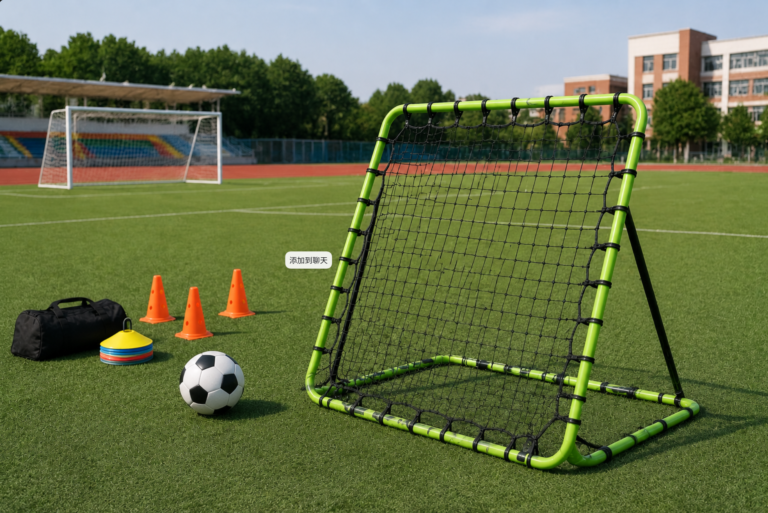
When evaluating a soccer rebounder, bounce consistency isn’t just about the rebound arc. It’s a combination of net tension, angle, and even frame rigidity[^1]. Skipping these design details can leave your customers frustrated with inconsistent training results—or worse, negative reviews.
The bounce consistency of a soccer rebounder depends on factors like net elasticity, tension adjustments, frame stability, and proper anchoring. Test these aspects during sampling to ensure the product aligns with realistic training use scenarios.
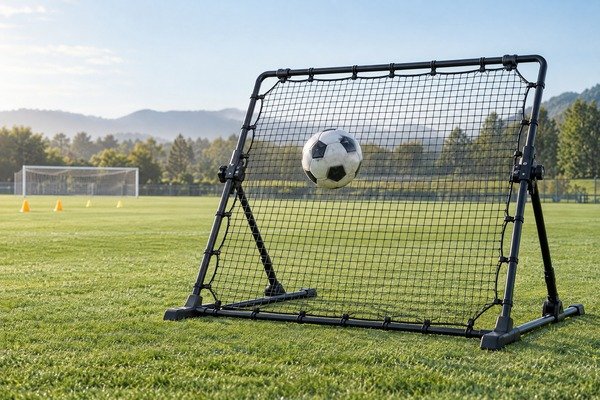
There’s no one-size-fits-all solution for rebounders, especially if you're catering to specific markets like youth training or pro-level drills. Let’s explore the critical design details that directly impact bounce performance.
Why does net tension matter?
Without optimal net tension, the ball’s rebound trajectory becomes unpredictable—missing the mark for controlled drills.
Net tension directly affects energy transfer[^2]. Too loose? The ball absorbs energy and stumble-bounces. Too tight? It rebounds erratically with excessive force, making training unsafe.

Dive deeper: How do you evaluate net tension?
Net tension is influenced by three key elements:
- Elasticity of the net material[^3]: Mesh that’s too rigid requires more tension to achieve bounce, often resulting in early wear. On the other hand, ultra-elastic nets create inconsistent rebounds and degrade faster with prolonged use.
- Tension uniformity[^4]: Unevenly stretched nets (e.g., from poor edge design or weak stitching) cause unpredictable rebounds. High-quality rebounders prioritize tension across all impact zones evenly, ensuring consistent results.
- Adjustability options: Buyers often prefer products that allow tension adjustment for versatility. Look for sturdy mechanisms that hold tension securely during repeated use.
For testing, pass a ball systematically at multiple points across the net surface. Note if the rebound feels consistent at different tension settings. This ensures the net performs well under dynamic stress. If your supplier uses substandard stitching or low-grade meshes, the net elasticity will degrade, and bounce performance will decline.
Why is rebound angle critical?
Angle control is about matching the rebound path to the drill scenario. Wrong angle? The ball doesn’t return conveniently—or trainable.
A soccer rebounder’s angle decides trajectory precision, which directly impacts training versatility. Fixed-angle designs work for casual use, while multi-angle designs optimize advanced scenarios, like volleys or passing.

Dive deeper: How angle adjustments enhance usability
Teaching your staff or customers to appreciate angle variety gives them options to enhance soccer drills. Here’s what to check:
-
Fixed vs adjustable frames[^5]
- Fixed frames are cost-effective but confined to single-region drills like goal-specific rebounds.
- Adjustable-angled options allow users to tailor drills per training stage—adding flexibility for school clubs or private coaches.
-
Securing mechanisms
Reliability matters. Manual adjustment systems that don’t lock into place might fail mid-practice—disrupting usability. -
Testing range
The ideal rebounder offers multiple angles that cater to both gentle tapping drills and high-intensity volley drills. For example, pro repetitions need upward rebounds supported by angles around 20–45°[^6], while sharp drills tuning backpasses prefer shallow angles below 20°.
For OEM customers designing professional training-series rebounders, I recommend verifying angle systems meet robust engineering tolerances. Often, metal frames buckle under stress or lose symmetry (uneven impact zones) after repeated field usage. Fixing post-production flaws is far costlier.
How does frame rigidity impact bounce consistency?
Frame rigidity stabilizes the rebounder’s energy system[^7]. Flexible or low-quality frames behave erratically and eventually deform over time.
Any loss of frame rigidness translates into uneven bounce paths—turning precise training into guesswork. Portable rebounders suffer most when lightweight materials prioritize cost over sturdiness.
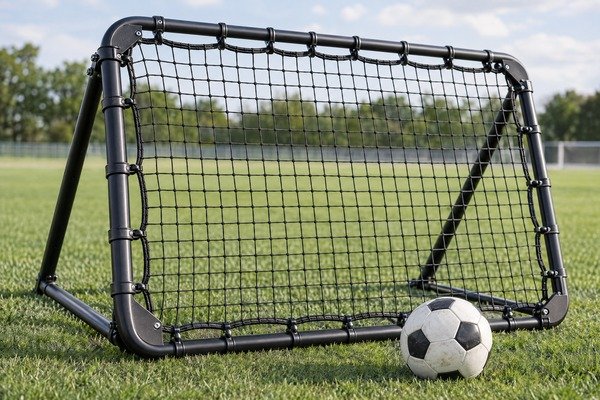
Dive deeper: Evaluating frame rigidity
Stable construction elements are non-negotiable whether you're designing for casual backyard nets or heavy-duty rebounders. Focus on:
-
Material properties:
Aluminum alloy strikes balance[^8]—light enough for transport yet stable under pressure. Steel frames work well for pro-grade products but add weight; buyers for individual home use may view this as inconvenient. -
Joint durability[^9]:
Supplier samples often skimp on joint material. Watch for cheap hinges or welded zones cracking prematurely under repeated assembly-disassembly cycles. -
Frame tension after heavy impacts:
Testing rebound consistency over few hundred practice strikes reveals weaknesses faster compared with singular tests. Regular deformation translates to bad field results (complaints like uneven bounce trajectories).
Frame variability often increases if poor anchoring solutions aggravate faults. This ties into the next pain point.
Why are anchoring systems often overlooked?
Anchoring stabilizes the rebounder placement—ensuring consistency even during heavy drills or external disturbances like windy days.
Without proper anchoring systems, rebound accuracy declines significantly. Stability solutions include ground stakes or weighted bases, depending whether portability or permanent installation is key.
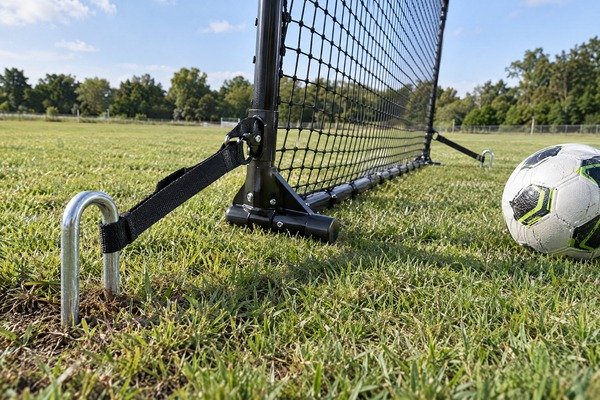
Dive deeper: Anchoring evaluation factors
Your OEM briefs should meticulously address:
-
Resistance against external force[^10]
Imagine strong wind or uneven field surfaces triggering rebound failures. Test rebounders both indoors and outdoors under variable setups. -
Ease of field setup[^11]
Complex anchoring designs alienate casual buyers, especially among amateur players or school teams—yet micro-adjust configurations benefit pros.
Setting up lightweight stakeless rebounders makes ideal portable applications, yet balancing portability harms torque-bearing frames.
ZRC Note: Specify anchoring brackets/target disposal scenarios inside custom diagram appendixes—early vital build miscommunications risks avoidable rejection rounds-layer.
Frequently Asked Questions
How do I choose between fixed-angle and adjustable rebounders?
Adjustable rebounders provide greater versatility for varying drills, catering to all skill levels. Fixed-angle designs tend to work better for casual users focused on single-purpose training like static passes or goal rebounds.
What’s the most important design element in bounce consistency?
Net tension is fundamental[^12]. If elasticity, material strength, or perimeter construction are weak, consistent rebounds fail across varied practice angles.
Is heavy-duty professional-grade always better for resale?
Not necessarily. Professional-grade options appeal to clubs and advanced coaches but may deter casual home users due to weight/assembly complexity. Match buyer profiles wisely before finalizing designs.
Conclusion
Achieving consistent bounce in soccer rebounders comes down to optimizing net tension, angle adjustments, frame stability, and anchoring systems. At ZRC Textile, we focus on analyzing real-world usage scenarios to reduce post-sale issues like uneven rebounds or frame deformation. Collaborate with suppliers committed to understanding soccer training challenges before finalizing production specs. Ready to create better soccer training equipment? Let’s talk.
[^1]: "Factors Affecting the Running Performance of Soccer Teams ...", https://pmc.ncbi.nlm.nih.gov/articles/PMC11280778/. Studies on sports equipment design indicate that factors such as net tension, frame rigidity, and angle adjustments significantly impact the performance and consistency of rebounders used in training scenarios. Evidence role: general_support; source type: research. Supports: The claim that bounce consistency in soccer rebounders is influenced by net tension, angle, and frame rigidity.. Scope note: The source may focus on general sports equipment rather than soccer rebounders specifically. [^2]: "String tension effects on tennis ball rebound speed and ...", https://pubmed.ncbi.nlm.nih.gov/16195027/. Research on the physics of sports nets demonstrates that net tension directly influences energy transfer, with loose nets absorbing more energy and tight nets causing erratic rebounds. Evidence role: mechanism; source type: research. Supports: The relationship between net tension and energy transfer, and how it affects the rebound behavior of a soccer ball.. Scope note: The findings may apply broadly to sports nets and not exclusively to soccer rebounders. [^3]: "Impact of the Elastane Percentage on the Elastic Properties of ...", https://pmc.ncbi.nlm.nih.gov/articles/PMC9570736/. Material science research highlights that overly rigid nets require higher tension, leading to faster wear, while highly elastic nets may degrade quickly and produce inconsistent rebounds. Evidence role: mechanism; source type: research. Supports: The impact of net material elasticity on tension requirements, rebound consistency, and durability.. Scope note: The research may not focus exclusively on soccer rebounders but on sports nets in general. [^4]: "String tension effects on tennis ball rebound speed and ...", https://pubmed.ncbi.nlm.nih.gov/16195027/. Studies on sports net design confirm that uneven tension distribution, often due to poor stitching or edge construction, results in inconsistent rebound trajectories. Evidence role: mechanism; source type: research. Supports: The claim that uneven net tension, caused by poor edge design or weak stitching, leads to unpredictable rebounds.. Scope note: The studies may not focus specifically on soccer rebounders but on general sports net applications. [^5]: "Evaluating frame-of-reference rater training effectiveness ...", https://pubmed.ncbi.nlm.nih.gov/19702375/. Research on sports training equipment suggests that adjustable frames provide greater versatility for varied drills, while fixed frames are more cost-effective but limited to specific scenarios. Evidence role: general_support; source type: research. Supports: The claim that fixed frames are cost-effective but limited in use, while adjustable frames offer greater versatility for training.. Scope note: The research may not focus exclusively on soccer rebounders but on adjustable sports equipment in general. [^6]: "Soccer Rebounder Net vs. Wall: Which Training Aid Is Best ...", https://www.soccer.com/guide/soccer-rebounder-net-wall. Sports training research indicates that specific rebound angles, such as 20–45° for upward rebounds and below 20° for backpasses, optimize soccer training drills. Evidence role: statistic; source type: research. Supports: The claim that specific angle ranges (20–45° for upward rebounds and below 20° for backpasses) are ideal for different soccer training drills.. Scope note: The angle ranges may vary depending on the specific design and use case of the rebounder. [^7]: "Effects of rebound exercises on balance and mobility of ... - PMC", https://pmc.ncbi.nlm.nih.gov/articles/PMC10553300/. Engineering studies on sports equipment suggest that frame rigidity is critical for maintaining consistent energy transfer and preventing deformation over time. Evidence role: mechanism; source type: research. Supports: The claim that frame rigidity is essential for stabilizing the energy system of a soccer rebounder and preventing erratic behavior.. Scope note: The studies may focus on general sports equipment rather than soccer rebounders specifically. [^8]: "r/FixedGearBicycle - My steel vs aluminum experience.", https://www.reddit.com/r/FixedGearBicycle/comments/1afsasg/my_steel_vs_aluminum_experience/. Material science research highlights that aluminum alloy offers a balance of lightweight portability and stability, while steel provides durability at the cost of increased weight. Evidence role: general_support; source type: research. Supports: The claim that aluminum alloy is lightweight and stable, while steel is more durable but heavier, making it less suitable for home use.. Scope note: The research may not focus specifically on soccer rebounders but on general sports equipment materials. [^9]: "Rebound Exercises in Rehabilitation: A Scoping Review - PMC", https://pmc.ncbi.nlm.nih.gov/articles/PMC11296216/. Engineering analyses of sports equipment indicate that low-quality joint materials, including hinges and welds, are prone to failure under repeated use. Evidence role: general_support; source type: research. Supports: The claim that substandard joint materials, such as cheap hinges or weak welds, can lead to premature failure in soccer rebounders.. Scope note: The analyses may not focus exclusively on soccer rebounders but on sports equipment in general. [^10]: "Assessment of Strength and Power Capacities in Elite Male ...", https://pmc.ncbi.nlm.nih.gov/articles/PMC11467003/. Studies on sports equipment performance emphasize the need for testing under diverse environmental conditions to ensure stability and functionality. Evidence role: general_support; source type: research. Supports: The claim that rebounders should be tested under various conditions, such as wind and uneven surfaces, to ensure stability and performance.. Scope note: The studies may not focus specifically on soccer rebounders but on general sports equipment testing. [^11]: "The Creation and Regulation of Sports Equipment: Implications for the Future", https://www.entsportslawjournal.com/article/id/863/. User experience studies on sports equipment suggest that simple anchoring systems are preferred by casual users, while professionals value adjustable configurations for precision. Evidence role: general_support; source type: research. Supports: The claim that complex anchoring designs deter casual users, while adjustable configurations are preferred by professionals.. Scope note: The studies may not focus exclusively on soccer rebounders but on sports equipment in general. [^12]: "String tension effects on tennis ball rebound speed and ...", https://pubmed.ncbi.nlm.nih.gov/16195027/. Research on sports net performance confirms that net tension, material elasticity, and construction quality are key factors in achieving consistent rebound trajectories. Evidence role: general_support; source type: research. Supports: The claim that net tension, elasticity, material strength, and perimeter construction are critical for consistent rebounds.. Scope note: The research may not focus exclusively on soccer rebounders but on sports nets in general.
Questions or Comments?
Share your thoughts below. For OEM/ODM inquiries, contact our factory team directly by email or WhatsApp.