How Schools Choose the Right Sports Safety Nets
Choosing the right sports safety nets for schools is more complex than it seems. Schools worldwide have strict safety standards, government procurement processes, and unique user needs.[^1] These factors create both challenges and opportunities for suppliers targeting this market.
Schools require sports safety nets that balance stringent compliance, low maintenance, and student safety. Meeting these requirements involves navigating certifications, long procurement cycles, and tailored product designs.
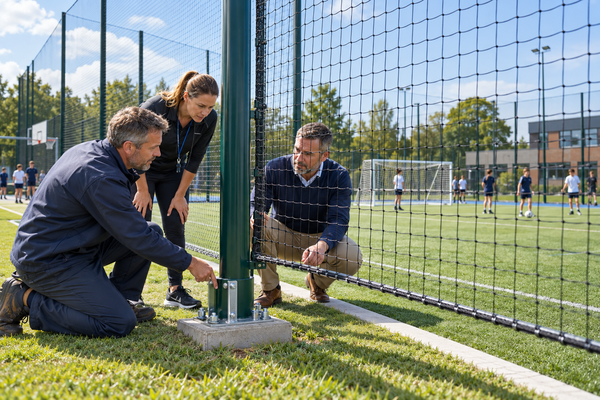
Understanding how schools make their purchasing decisions is key to meeting these demands effectively. Let’s explore the unique factors that shape this market and what suppliers need to know.
Why do schools require specialized sports safety nets?
School sports safety nets face very different demands than recreational or professional sports nets. The problem lies in their specific safety and compliance requirements.
School safety nets must comply with strict, child-focused safety standards and withstand long-term use with minimal maintenance.[^2] This includes flame resistance, non-toxic materials, and gradual failure modes rather than sudden breaks.[^3]
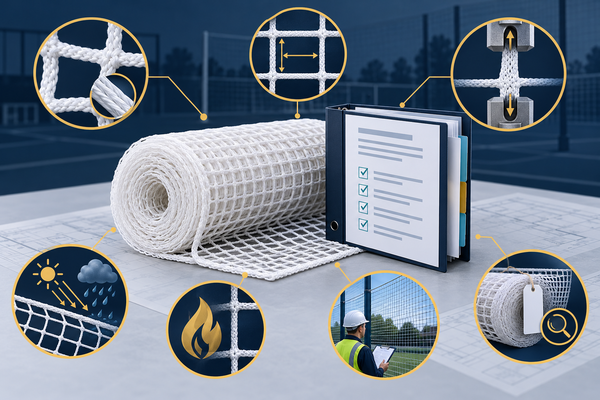
For example, in the U.S., school playground equipment must follow standards like ASTM F1487 and the CPSC Handbook for Public Playground Safety. These include mandatory flame-resistance testing (CPSC 16 CFR Part 1610) and lead content restrictions (maximum 100 ppm per CPSIA guidelines). Metal fittings must also avoid sharp edges or cutting surfaces.[^4]
Schools prioritize children’s safety above all else, which means suppliers need to pay close attention to these technical requirements. Without proper compliance, products risk being disqualified outright.
Key differences between school and recreational safety nets
| Feature | School Safety Nets | Recreational/Training Nets |
|---|---|---|
| Compliance standards | ASTM, CPSC, CPSIA, local certifications | General sports equipment standards |
| Material toxicity limits | Strict (e.g., lead ≤ 100 ppm) | Less strict or industry-specific |
| Fire resistance | Mandatory | Optional |
| Maintenance expectations | Low maintenance, gradual failures | Varies; not always prioritized |
What makes the school procurement process unique?
The complexity of school purchasing comes from its multi-layered decision-making structure. Unlike retail buyers or distributors, schools operate within government frameworks.
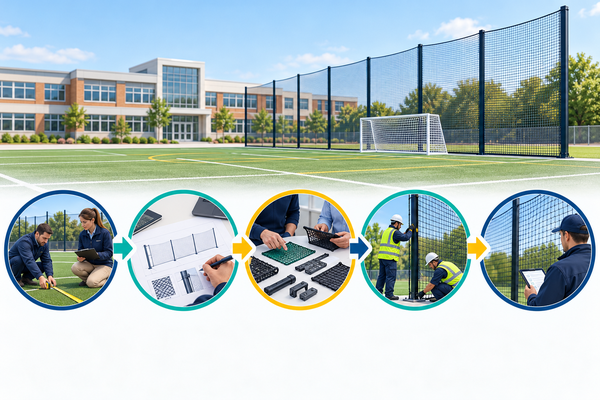
This decision-making process can take 3–12 months, depending on the jurisdiction. Suppliers must align their offerings with these timelines and prepare all related documentation well in advance to qualify during the bidding stage.[^6]
Required documents for school procurement
- Product certification reports (e.g., ASTM, CPSC compliance)
- Material safety data sheets (MSDS)
- Flame resistance test results
- Installation manuals
- Liability insurance certifications
- Warranty details for up to 10 years
Suppliers without these documents risk immediate disqualification. Furthermore, unlike consumer markets, school buyers rarely allow flexibility on compliance—so being proactive is crucial.
Why do schools prioritize low-maintenance products?
Maintenance is a hidden but powerful consideration in school purchases. Most schools lack dedicated staff to monitor or repair sports safety nets regularly. As a result, they look for products with low maintenance requirements.
The critical requirement is for the safety nets’ failure mode to be gradual and detectable. HDPE knotless nets, for instance, degrade visibly over time, offering clear warning signs before failure.[^7] In contrast, knotted nets may fail suddenly at tension points, risking student safety.
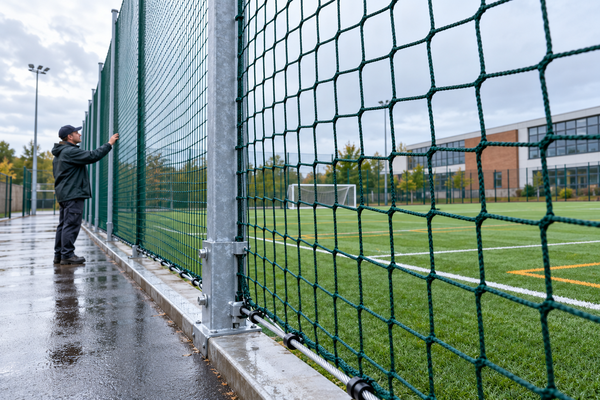
This makes HDPE knotless nets a preferred choice. Although 10–20% more expensive than knotted options, their durability and gradual degradation reduce long-term risks and maintenance burdens.[^8]
Benefits of HDPE knotless nets for schools
- Visible degradation: Gradual loosening indicates wear and tear.
- Durability: Resistant to weather, UV rays, and high-wear conditions.
- Safety-first: Minimal risk of sudden failure in high-use environments.
For these reasons, focusing on a low-maintenance product design tailored for the school environment can offer significant market differentiation.
What challenges do suppliers face in entering this market?
The school safety net market offers high barriers to entry, but it also comes with lower competition. One of the largest challenges for Chinese suppliers is the certification gap.
Most Chinese factories obtain general international certifications (like SGS or Intertek).[^9] However, they often lack the country-specific school certifications required for eligibility in tenders.

Without ASTM, BSI, or AS/NZS-compliant certifications, Chinese manufacturers cannot directly access government-funded contracts.[^10] Partnering with a local distributor is often the best way to bridge this gap.[^11] Distributors typically handle compliance localization, tender participation, and liability insurance.
The two-tier approach for success in school markets
- Manufacturing expertise: Build high-quality, customized products at competitive costs.
- Compliance localization: Work with local distributors to handle certifications and procurement-specific paperwork.
By combining these two elements, suppliers can establish themselves as reliable, compliant partners in the school market.
Frequently Asked Questions
What are the primary certifications required for U.S. schools?
For U.S. schools, essential certifications include ASTM F1487 (playground safety standard), CPSC 16 CFR Part 1610 (flame resistance), and CPSIA (lead content limits of ≤ 100 ppm). Suppliers must provide testing reports to verify compliance.
How long does the school procurement process take?
The school procurement cycle can last anywhere from 3 to 12 months. This process includes identifying needs, securing budgets, floating tenders, and evaluating bids. Planning ahead is essential.
Why are HDPE knotless nets preferred by schools?
HDPE knotless nets are favored because they degrade visibly over time (gradual failure), making maintenance easier. They are also more durable and weather-resistant than traditional knotted nets.
Can international suppliers compete in the school market?
Yes, but international suppliers often require local partnerships to handle certifications, insurance, and procurement procedures. Without these, accessing school tenders is difficult.
Are sports safety nets in schools replaced often?
Yes. Most school tenders for sports safety nets occur every 3–5 years due to wear and tear. Proper documentation and compliance remain key for repeat contracts.
Conclusion
Schools choose sports safety nets based on compliance, safety, and maintenance factors. Meeting their needs involves strict adherence to ASTM/CPSC standards, understanding long procurement timelines, and focusing on low-maintenance designs like HDPE knotless nets.
For suppliers, the school market offers steady demand but high entry barriers due to its certification and documentation requirements. Strategic partnerships with local distributors can unlock opportunities in this niche market.
Ready to tap into the school sports needs market? Reach out to explore how we can help you develop compliant, low-maintenance solutions tailored for schools worldwide.
[^1]: "CHAPTER 7-PROCUREMENT State agencies and public ...", https://snp.ade.arkansas.gov/PDF/NSLP%20Training%20Materials/NSLP%20Resource%20Manual%20Chapter%207%20Procurement.pdf. International standards for school safety equipment, such as those outlined by UNESCO and ISO, emphasize compliance with child-focused safety and procurement regulations. These standards vary by region but share common principles of safety and durability. Evidence role: general_support; source type: institution. Supports: Schools worldwide have strict safety standards and procurement processes.. Scope note: Specific examples of standards or processes may vary significantly by country. [^2]: "Public Playground Safety Handbook", https://www.cpsc.gov/s3fs-public/325.pdf. The U.S. Consumer Product Safety Commission (CPSC) outlines safety standards for playground equipment, including durability and child-focused safety measures, which are applicable to sports safety nets. Evidence role: general_support; source type: government. Supports: School safety nets must meet child-focused safety standards and durability requirements.. Scope note: The standards referenced are specific to the U.S. and may not apply globally. [^3]: "1926.105 - Safety nets.", http://www.osha.gov/laws-regs/regulations/standardnumber/1926/1926.105. Research on material science for safety equipment highlights the importance of flame resistance and non-toxic materials in environments with children, as well as the engineering of gradual failure modes to prevent sudden accidents. Evidence role: mechanism; source type: research. Supports: Safety nets for schools should include flame resistance, non-toxic materials, and gradual failure modes.. Scope note: The research may focus on general safety equipment rather than sports nets specifically. [^4]: "Personal Protective Equipment - Overview", http://www.osha.gov/personal-protective-equipment. Educational safety guidelines emphasize the importance of rounded or smooth metal fittings in equipment used by children to prevent injuries. Evidence role: mechanism; source type: education. Supports: Metal fittings in school safety nets should avoid sharp edges to ensure child safety.. Scope note: The guidelines may not specifically address sports safety nets but apply broadly to child-focused equipment. [^5]: "Buyer decision process", https://en.wikipedia.org/wiki/Buyer_decision_process. Institutional procurement guidelines for schools often outline multi-stage processes involving need identification, budget approval, and compliance verification. Evidence role: general_support; source type: institution. Supports: School purchasing decisions involve multiple stages, including compliance checks and tender coordination.. Scope note: The process may vary significantly by country or jurisdiction. [^6]: "The Purchase and Care of Athletic Equipment", https://thekeep.eiu.edu/cgi/viewcontent.cgi?article=1090&context=plan_b. Educational procurement frameworks often require suppliers to submit detailed documentation, including certifications and compliance reports, well in advance of tender deadlines. Evidence role: general_support; source type: education. Supports: Suppliers need to align with school procurement timelines and prepare documentation for bidding.. Scope note: Specific timelines and requirements may differ by region. [^7]: "Environmental Aging Effects on the Thermal Oxidative ...", https://ui.adsabs.harvard.edu/abs/2026JMSB...65..707N/abstract. Material science research on HDPE knotless nets indicates their gradual degradation under stress, which enhances safety by providing visible warning signs. Evidence role: mechanism; source type: research. Supports: HDPE knotless nets degrade visibly over time, providing warning signs before failure.. Scope note: The research may focus on general HDPE applications rather than school-specific use cases. [^8]: "Hydrodynamic characteristics of knotted and knotless purse ...", https://pmc.ncbi.nlm.nih.gov/articles/PMC5805286/. Studies comparing HDPE knotless and knotted nets show higher upfront costs for knotless designs but lower maintenance needs and reduced risk of sudden failure. Evidence role: statistic; source type: research. Supports: HDPE knotless nets are more expensive but reduce long-term risks and maintenance burdens.. Scope note: Cost and maintenance data may vary by manufacturer and region. [^9]: "OSHA's Nationally Recognized Testing Laboratory (NRTL) ...", http://www.osha.gov/nationally-recognized-testing-laboratory-program/sgs. Reports from certification bodies such as SGS and Intertek confirm widespread adoption of their standards by Chinese manufacturers for international markets. Evidence role: general_support; source type: institution. Supports: Chinese factories often obtain general international certifications like SGS or Intertek.. Scope note: The certifications may not specifically address school safety net requirements. [^10]: "Government Contracting", https://www.webster.edu/catalog/current/graduate-catalog/certificates/government-contracting-gcrt.html. Procurement guidelines for government contracts frequently mandate compliance with ASTM, BSI, or AS/NZS standards to ensure product safety and reliability. Evidence role: case_reference; source type: government. Supports: Government-funded contracts often require ASTM, BSI, or AS/NZS-compliant certifications.. Scope note: Specific certification requirements may vary by country and contract type. [^11]: "Certificate in Localization: Customizing Software for the World", https://www.pce.uw.edu/certificates/localization-customizing-software-for-the-world. Industry reports suggest that local distributors play a key role in helping international manufacturers navigate certification and procurement requirements in school markets. Evidence role: expert_consensus; source type: institution. Supports: Partnering with local distributors helps manufacturers bridge certification gaps.. Scope note: The effectiveness of such partnerships may depend on the distributor's expertise and regional knowledge.
Questions or Comments?
Share your thoughts below. For OEM/ODM inquiries, contact our factory team directly by email or WhatsApp.