HDPE vs Nylon Sports Nets: Which Material Is Better for Outdoor Applications?
Choosing the right material for outdoor sports nets can be the difference between long-term durability and frequent replacements. HDPE (high-density polyethylene) and Nylon (polyamide) are two popular choices[^1], but their differences in chemical structure directly impact performance in outdoor environments. So, which material is better suited for your needs?
HDPE is the superior option for outdoor sports nets due to its low moisture absorption rate (<0.01%), higher UV resistance, and stable mechanical properties over time.[^2] Nylon, on the other hand, absorbs significant moisture (8–10%), reducing its strength outdoors and making it less UV-resistant.
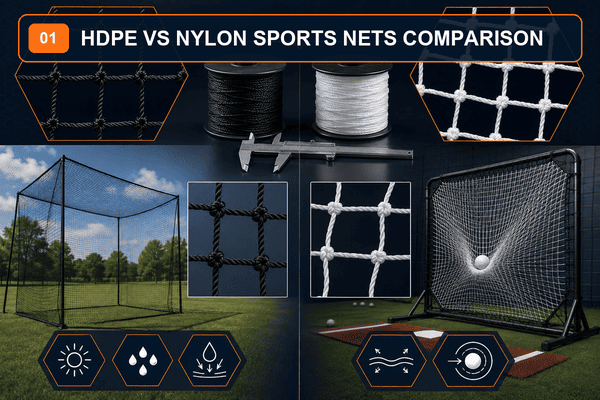
Whether you need nets for a sports stadium or temporary outdoor training setups, understanding the differences between HDPE and Nylon—and even Polyester—can help ensure longevity and performance. Let’s break it down further.
Why is HDPE a better choice for permanent outdoor sports nets?
Outdoor sports nets face constant exposure to sunlight, humidity, temperature fluctuations, and physical stress. HDPE’s properties make it ideal for these challenges.
HDPE offers unparalleled UV resistance, low moisture absorption (<0.01%), and consistent mechanical strength even in harsh weather conditions. It is chemically stable, lightweight, and designed to resist cracking, ensuring its suitability for long-term installations.
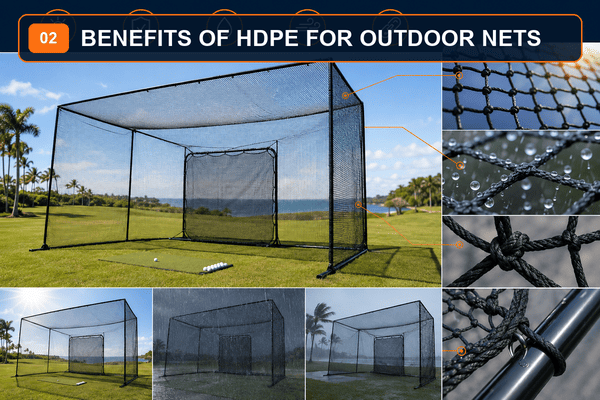
Dive deeper into HDPE’s key performance advantages:
- UV Stability: HDPE, especially with UV stabilizers, resists degradation under prolonged sun exposure. Nylon degrades quickly unless additives are used, losing strength 2–3 times faster than HDPE.
- Minimal Moisture Absorption: With an absorption rate <0.01%, HDPE retains its mechanical properties in humid or rainy conditions. Nylon absorbs 8–10% of its weight in moisture, weakening its structure by 15–20%.
- Longevity in Tough Environments: HDPE withstands extreme cold and doesn’t brittle like polypropylene under low temperatures[^3], making it ideal for year-round outdoor installations.
| Use Case Matrix (HDPE): | Application | Material Recommendation |
|---|---|---|
| Driving Range Nets | UV-stable HDPE knotted or knotless nets | |
| Stadium Enclosures | UV-stable HDPE, reinforced at stress points | |
| Seasonal School Sports Nets | HDPE (preferred for durability) |
When is Nylon suitable for sports nets?
Not all sports net applications benefit from HDPE. Indoor environments or situations requiring elasticity and vibrant aesthetics lean in favor of Nylon.
Nylon’s elasticity makes it ideal for impact absorption in high-energy scenarios[^4], such as martial arts or children’s indoor play areas. Additionally, it offers the softest texture and vibrant color retention compared to HDPE.
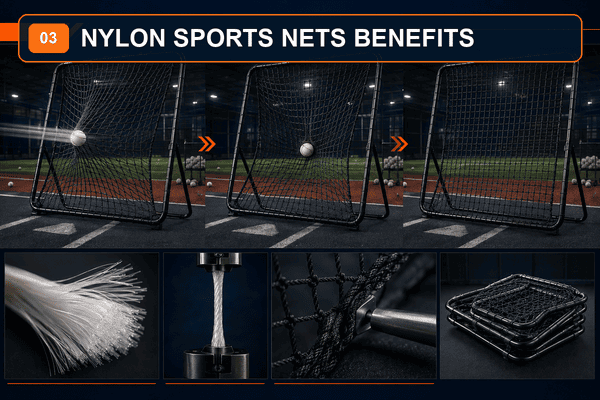
Dive deeper into Nylon’s unique advantages:
- Elasticity for Shock Absorption: Nylon’s lower modulus of elasticity makes it stretch effectively under impact, reducing stress transfer compared to HDPE. This property is essential in nets used for indoor sports requiring safety cushions.
- Bright Dyeability & Soft Texture: Nylon is unmatched for indoor decorative nets where vivid colors are favored. Its soft hand feels safer for settings where direct skin contact occurs.
- Cost Considerations: While Nylon costs more than HDPE, its durability in indoor environments makes it cost-effective for non-UV-exposed use cases.
| Use Case Matrix (Nylon): | Application | Material Recommendation |
|---|---|---|
| Martial Arts Impact Nets | Elastic Nylon netting | |
| Children’s Indoor Play Areas | Nylon for softness and safety | |
| Decorative Indoor Nets | Nylon dyed in vibrant colors |
Is Polyester the overlooked middle ground for sports nets?
Polyester (PET) often gets overshadowed, but it’s worth considering for its balanced properties. Performance-wise, Polyester falls between HDPE and Nylon[^5], making it a cost-effective choice for indoor training nets and seasonal outdoor setups.
Polyester offers low moisture absorption (0.2–0.4%) and decent UV resistance[^6]—but its UV stability is weaker than HDPE, and it performs better for short-term or indoor applications.
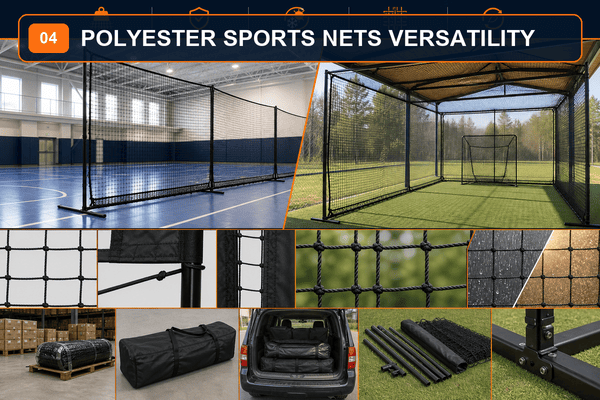
Dive deeper into Polyester’s pros and cons:
- Cost Efficiency: As the cheapest option, and with China being the largest Polyester fiber producer globally[^7], Polyester nets are extremely accessible with stable pricing.
- Good for Non-Permanent Outdoor Use: For nets used only during certain seasons, Polyester’s balance between strength, cost, and moderate UV resistance shines.
- Indoor Application Compatibility: Hands-down, Polyester meets budget constraints for gyms and training facilities where weather exposure is minimal.
| Use Case Matrix (Polyester): | Application | Material Recommendation |
|---|---|---|
| Seasonal Outdoor Training Nets | Standard Polyester nets | |
| Backyard Practice Nets | Lightweight Polyester nets | |
| Indoor Gym Training Nets | Cost-friendly Polyester options |
Why is material verification critical when sourcing from China?
When buying sports nets from China, claims about materials are often unreliable. Mislabeling HDPE for recycled HDPE or switching to polypropylene (PP) happens frequently, impacting durability, especially in outdoor applications.
Always request material testing reports for virgin HDPE versus recycled[^8], check UV stabilizer percentages, and avoid PP for cold weather regions where brittleness becomes a major issue.
Key tips for verifying sports net materials:
- HDPE vs Recycled HDPE: Recycled HDPE has 30–40% weaker strength and costs about 25–35% less[^9]. Mislabeling is common, so factory claims alone aren’t sufficient.
- Distinguish PP from HDPE: Polypropylene visually resembles HDPE but becomes brittle <0°C[^10], unsuitable for outdoor nets in cold climates.
- Inspection Practices: Always ask suppliers for lab results, detailed specs, or even third-party certifications that prove material authenticity.
Frequently Asked Questions
Why does moisture absorption matter in sports nets?
High moisture absorption, as seen in Nylon (8–10%), reduces tensile strength by 15–20%[^11], especially in wet conditions. HDPE and Polyester remain stable, with absorption rates <0.01% and 0.2–0.4%, respectively.
Are Polyester nets strong enough for permanent outdoor use?
No, Polyester nets are better for seasonal outdoor or indoor use. They're affordable but less UV-resistant than HDPE, making them unsuitable for long-term outdoor facilities.
How do I ensure true HDPE when sourcing from China?
Request material testing reports specifically for virgin HDPE. Avoid relying on supplier claims alone and watch for cheaper substitutes like recycled HDPE or polypropylene.
Conclusion
When deciding between HDPE, Nylon, and Polyester sports nets, the choice boils down to application-specific needs. HDPE excels in permanent outdoor installations due to its UV stability and moisture resistance. Nylon’s elasticity and vibrant color shine for indoor or decorative purposes. Polyester serves as a cost-effective option for seasonal setups or indoor use.
Understanding material performance—and verifying authenticity—ensures you choose the right solution without compromising quality. Contact us for trusted, OEM-grade sports net sourcing tailored to your needs.
[^1]: "Indoor vs. Outdoor Sports Netting Systems", https://tiffinscenic.com/blog/indoor-vs-outdoor-sports-netting-systems/. Research indicates that HDPE and Nylon are among the most commonly used materials for manufacturing outdoor sports nets due to their durability and performance characteristics. Evidence role: general_support; source type: research. Supports: HDPE and Nylon are commonly used materials for outdoor sports nets.. Scope note: The source may not provide specific market share data or comprehensive global usage statistics. [^2]: "HDPE sheets outdoor and UV exposure properties FAQ", https://www.grafixplastics.com/hdpe-sheets-suitable-outdoor-use/. Studies on HDPE confirm its low moisture absorption (<0.01%), high UV resistance, and stable mechanical properties, which are advantageous for outdoor applications. Evidence role: mechanism; source type: research. Supports: HDPE has low moisture absorption, high UV resistance, and stable mechanical properties, making it suitable for outdoor sports nets.. Scope note: The source may not directly compare HDPE to Nylon or other materials in the context of sports nets. [^3]: "Low-Temperature Mechanical Properties of High-Density and ...", https://pmc.ncbi.nlm.nih.gov/articles/PMC8198324/. Studies confirm that HDPE maintains its mechanical properties in extreme cold, unlike polypropylene, which becomes brittle at low temperatures. Evidence role: mechanism; source type: research. Supports: HDPE is resistant to extreme cold and does not become brittle like polypropylene.. Scope note: The source may not specifically focus on sports net applications. [^4]: "Nylon - Wikipedia", https://en.wikipedia.org/wiki/Nylon. Research highlights Nylon's high elasticity, which allows it to absorb impacts effectively, making it suitable for high-energy applications. Evidence role: mechanism; source type: research. Supports: Nylon's elasticity makes it effective for impact absorption in high-energy scenarios.. Scope note: The source may not directly compare Nylon's elasticity to other materials like HDPE. [^5]: "Nylon vs. Polyester: Differences and Similarities - Xometry", https://www.xometry.com/resources/materials/nylon-vs-polyester/. Comparative studies of Polyester, HDPE, and Nylon indicate that Polyester offers a balance of properties, with performance falling between the other two materials. Evidence role: general_support; source type: research. Supports: Polyester's performance characteristics are intermediate between HDPE and Nylon.. Scope note: The source may not focus exclusively on sports net applications. [^6]: "Sun‐protective Properties of Technical Sportswear Fabrics ...", https://pmc.ncbi.nlm.nih.gov/articles/PMC10086949/. Studies indicate that Polyester has a moisture absorption rate of 0.2–0.4% and moderate UV resistance, making it suitable for certain outdoor applications. Evidence role: mechanism; source type: research. Supports: Polyester has low moisture absorption (0.2–0.4%) and moderate UV resistance.. Scope note: The source may not specifically address the use of Polyester in sports nets. [^7]: "Best 10 Polyester Manufacturers in the world 2025 - Blog", https://www.worldbestjason.com/blog/best-10-polyester-manufacturers-in-the-world-2092892.html. According to global trade and industry reports, China is the leading producer of Polyester fiber worldwide. Evidence role: statistic; source type: government. Supports: China is the largest producer of Polyester fiber globally.. Scope note: The source may not provide the most recent production data. [^8]: "HDPE Pipe Quality Control/Quality Assurance Program", https://connect.ncdot.gov/resources/Materials/MaterialsResources/HDPE%20Pipe%20QC-QA%20Program.pdf. Industry guidelines recommend material testing reports as a reliable method to verify the authenticity of virgin HDPE compared to recycled HDPE. Evidence role: expert_consensus; source type: institution. Supports: Material testing reports are a reliable method to distinguish virgin HDPE from recycled HDPE.. Scope note: The source may not provide specific testing methodologies. [^9]: "Structural and Mechanical Properties of Recycled HDPE with ...", https://pmc.ncbi.nlm.nih.gov/articles/PMC11642715/. Studies on recycled HDPE indicate that it has 30–40% lower tensile strength and is 25–35% cheaper compared to virgin HDPE. Evidence role: statistic; source type: research. Supports: Recycled HDPE is 30–40% weaker in strength and costs 25–35% less than virgin HDPE.. Scope note: The source may not focus on sports net applications specifically. [^10]: "Polypropylene - Wikipedia", https://en.wikipedia.org/wiki/Polypropylene. Research confirms that polypropylene becomes brittle at temperatures below 0°C, whereas HDPE maintains its structural integrity. Evidence role: mechanism; source type: research. Supports: Polypropylene becomes brittle at temperatures below 0°C, unlike HDPE.. Scope note: The source may not address the visual similarity between polypropylene and HDPE. [^11]: "Managing Moisture: The Science Behind Moisture Absorption in Nylon", https://etp.teknorapex.com/blog/moisture-absorption-in-nylon. Studies show that Nylon's tensile strength decreases by 15–20% when it absorbs 8–10% of its weight in moisture. Evidence role: statistic; source type: research. Supports: Nylon's tensile strength decreases by 15–20% due to its high moisture absorption (8–10%).. Scope note: The source may not focus on outdoor sports net applications.
Questions or Comments?
Share your thoughts below. For OEM/ODM inquiries, contact our factory team directly by email or WhatsApp.