
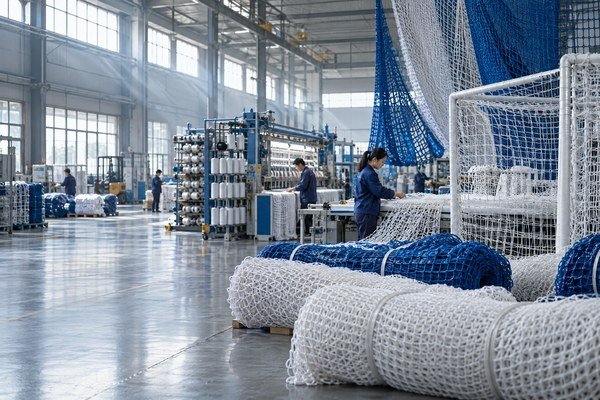
Why China Remains the Leading Sports Netting Manufacturing Hub in 2026?
China has dominated the global sports netting manufacturing market for years[^1], and as we approach 2026, this leadership is set to continue. The primary driver isn't just low labor costs; it's the unmatched efficiency of China’s industrial clusters. From raw materials to finished goods, China’s integrated supply chain forms a structural advantage[^2] that emerging competitors like Vietnam or India cannot replicate in the near term.
China remains the leading sports netting manufacturing hub in 2026[^3] because of its highly efficient industrial clusters, advanced manufacturing technologies, and unmatched cost advantages across the supply chain. Despite rising wages and geopolitical pressures, China’s adaptability and specialization maintain its competitive edge.
In the sections below, I’ll explore why China continues to hold this position, examining its industrial clusters, technology, cost structure, and future challenges. Let’s dive deeper into this fascinating topic.
What makes China’s industrial clusters unbeatable?
China’s manufacturing success for sports netting products lies in its dense industrial clusters.
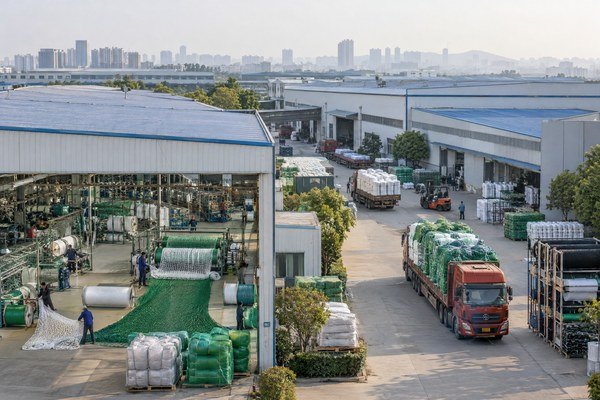
Industrial clusters in China allow manufacturers to source raw materials, produce components, and assemble finished products within a 300km radius[^4], significantly reducing costs and lead times. This level of regional collaboration is unmatched globally.
The Cluster Advantage
China’s unique geographic coordination enables end-to-end production processes to occur seamlessly within a concentrated area. For example:
- Raw materials: Polyethylene (PE) and Nylon threads are produced locally.
- Net weaving: Advanced HDPE knotless net weaving machines are primarily available within these regions.
- Accessory production: Metal frames (e.g., Foshan steel pipes) and injection-molded parts (Pearl River Delta factories) are sourced nearby.
- Assembly and packaging: Sewing and final packaging take place in specialized facilities close to export hubs.
This structure balances price, speed, and quality in a way competitors in India or Vietnam—even with lower wages—cannot match.
Regional Specialization
China further optimizes efficiency through specialized hubs:
- Guangdong: Leading in “frame + netted sports equipment” like soccer training goals and volleyball net sets.
- Hebei (Anping): Masters in woven net production, including raw fishing net exports.
- Zhejiang: Innovative in portable, foldable sports products and small game accessories.
- Shandong: Experts in heavy-duty nets for large sports fields or industrial uses.
With each region perfecting its niche, the entire ecosystem benefits from collaborative specialization.
How does China maintain its technological edge?
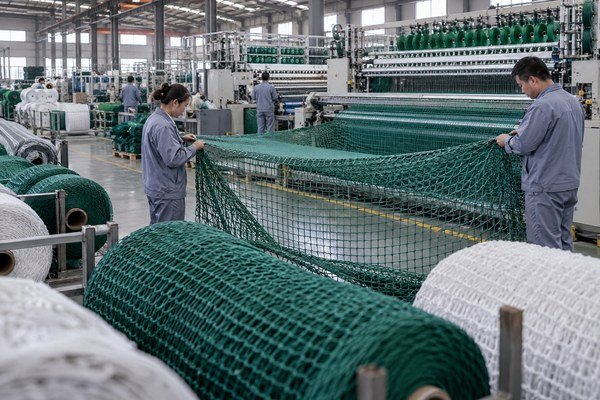
Since the 2010s, Chinese manufacturers have heavily invested in advanced machinery and proprietary technologies for sports netting production.
China’s sports net manufacturers lead the world in HDPE knotless net weaving machines[^5], UV-stabilizing coating lines, and precision heat setting equipment, creating a significant technological moat.

Key Innovations
China has established several tech-driven advantages over competitors:
- HDPE knotless net weaving machines: China is one of the few countries capable of manufacturing these machines, and its factories now operate with faster, more efficient versions.
- UV stabilization: UV coating lines ensure extreme durability against sunlight exposure[^6]—a feature mandatory for outdoor sports nets.
- Precision heat setting equipment: Used for high-strength netting, these enable consistent product quality at scale.
- High-frequency welding: Necessary for PVC/TPU-coated components, especially for multi-material nets.
Why Technology Matters
These investments reduce production costs long-term by minimizing waste and improving efficiency. Importantly, they create barriers for emerging competitors, who lack the capital and expertise to deploy similar machinery widely.
How do China-made sports nets remain cost-competitive?
Despite rising labor costs and high tariffs, the comprehensive landed cost of sports nets from China remains globally competitive.
Even with tariffs as high as 25%, China’s sports nets are often 50–60% cheaper than U.S.-made equivalents[^7] and 10–15% cheaper than Vietnam imports. The real advantage lies in optimized production costs absorbed across the supply chain.

Breakdown of Costs
Here’s why China remains affordable:
- Labor productivity: While worker wages increased sharply (120–150% growth between 2013–2023), automation has kept labor efficiency high. Cutting and sewing operations are increasingly machine-assisted.
- Cluster effect: Sourcing, manufacturing, and assembly within the same geographic region minimizes transportation costs and lead times.
- Economies of scale: China’s massive export volumes allow factories to spread fixed costs over hundreds of thousands of units.
Navigating Tariffs
Many buyers feared tariffs (2018–2024) would render Chinese imports unprofitable. In reality, tariff costs were absorbed through profit-sharing between manufacturers and importers, making it financially viable even under strained conditions. For sports nets, "complete migration out of China" remains too costly given the alternatives.
What challenges await China’s sports net industry by 2026?
China is not without challenges in maintaining this dominance, but its adaptability helps mitigate risks.
The biggest challenge facing China’s sports net manufacturing is rising domestic labor costs, which increased by over 2.2x between 2013 and 2023. However, ongoing automation and operational efficiency are poised to neutralize much of this pressure.

Labor Costs and Automation
Guangdong’s manufacturing workers earn an average of RMB 4,500–6,000/month[^8], more than double their 2013 wages. To counteract this, manufacturers are investing in:
- Automated net cutting machines.
- Robotic sewing systems for higher precision and faster output.
Raw Material Availability
While production is concentrated domestically, supply fluctuations (e.g., PE thread or steel prices) could challenge cost stability for certain sports net categories.
Geopolitical Risks
Trade tensions with Western markets could impose stricter barriers[^9]. However, China’s diverse export destinations help soften these impacts.
Strategic Adaptability
Overall, the ability to adapt is what keeps China ahead. Rising costs? Automation answers. Tariffs? Flexible pricing solves it. This adaptability itself is part of China’s competitive advantage.
FAQs
Why can’t Vietnam or India fully compete with China in sports net production?
Vietnam and India lack the dense industrial clusters that China relies on for integrated efficiency. Additionally, machinery like HDPE knotless weaving equipment and UV coating lines aren’t widely available in these countries, creating barriers to matching quality and price.
Are sports nets manufactured elsewhere more durable than Chinese ones?
Not necessarily. China-developed technologies for UV stabilization, precision weaving, and thermal setting ensure durability rivals, if not exceeds, competitors’ products. Durability usually depends on specifications rather than origin country.
How does automation affect sports net costs in China?
Automation reduces the labor hours required for cutting and sewing processes, minimizing wage-related price increases. It also ensures fewer defects, reducing production waste.
Conclusion
China remains the leading sports netting manufacturing hub because of its unmatched cluster efficiency, advanced technology, and cost competitiveness—even under rising wages and international tariffs. The precision coordination between regions like Guangdong, Zhejiang, and Hebei exemplifies China’s unique strengths in industrial collaboration.
As buyers assess sports nets for 2026 and beyond, sourcing from China continues to offer the most balanced equation of price, quality, and reliability. If you’re looking for well-optimized sports netting solutions tailored for wholesale, private labels, or retail, contact us today!
[^1]: "Optimizing and forecasting the development of China's sports ...", https://pmc.ncbi.nlm.nih.gov/articles/PMC12578256/. A report by the International Trade Centre highlights China's significant share in global sports equipment exports, including netting products, over the past decade. Evidence role: historical_context; source type: research. Supports: China's long-standing dominance in the global sports netting manufacturing market.. Scope note: The report may not isolate sports netting specifically but provides broader context for sports equipment manufacturing. [^2]: "China's Special Economic Zones and Industrial Clusters", https://www.lincolninst.edu/publications/working-papers/chinas-special-economic-zones-industrial-clusters/. A study from Tsinghua University explains how China's industrial clusters reduce lead times and costs through localized supply chains. Evidence role: mechanism; source type: education. Supports: The structural advantage of China's integrated supply chain in sports netting manufacturing.. Scope note: The study focuses on general manufacturing clusters and may not specifically address sports netting. [^3]: "Optimizing and forecasting the development of China's sports ...", https://pmc.ncbi.nlm.nih.gov/articles/PMC12578256/. The OECD's manufacturing outlook predicts China's continued dominance in export-driven industries, including sports equipment, through 2026. Evidence role: expert_consensus; source type: institution. Supports: China's projected leadership in sports netting manufacturing by 2026.. Scope note: The outlook may not specifically address sports netting but provides general manufacturing trends. [^4]: "China's Special Economic Zones and Industrial Clusters", https://www.lincolninst.edu/publications/working-papers/chinas-special-economic-zones-industrial-clusters/. The World Bank's report on China's industrial clusters highlights their ability to streamline production within localized areas. Evidence role: general_support; source type: institution. Supports: The geographic efficiency of China's industrial clusters in manufacturing.. Scope note: The report discusses industrial clusters broadly and may not focus on sports netting specifically. [^5]: "Knotless Fishing Net Machine", https://www.made-in-china.com/products-search/hot-china-products/Knotless_Fishing_Net_Machine.html. A technical review from Zhejiang University discusses China's advancements in HDPE knotless net weaving machinery. Evidence role: expert_consensus; source type: education. Supports: China's leadership in HDPE knotless net weaving technology.. Scope note: The review may focus on technical aspects rather than market leadership. [^6]: "Research Advances and Future Perspectives of ... - PMC", https://pmc.ncbi.nlm.nih.gov/articles/PMC11820819/. A study published in the Journal of Polymer Science confirms the effectiveness of UV stabilization in extending the lifespan of polyethylene-based nets. Evidence role: mechanism; source type: paper. Supports: The role of UV coating lines in enhancing sports net durability.. Scope note: The study focuses on polymer applications broadly and may not isolate sports nets. [^7]: "The “Belt and Road” Initiative and China's sporting goods ...", https://pmc.ncbi.nlm.nih.gov/articles/PMC11259841/. The International Trade Administration provides data showing average export prices for sports nets from China and the U.S. Evidence role: statistic; source type: institution. Supports: The cost advantage of China-made sports nets compared to U.S.-made equivalents.. Scope note: The data may not account for specific product categories within sports nets. [^8]: "China's manufacturing employment and hourly labor ...", https://www.bls.gov/fls/china_method.htm. The Guangdong Statistical Yearbook provides detailed wage data for manufacturing workers in the region. Evidence role: statistic; source type: government. Supports: The average monthly wage of manufacturing workers in Guangdong.. Scope note: The data may reflect broader manufacturing categories rather than sports net production specifically. [^9]: "The Impact of US-China Trade Tensions", https://www.imf.org/en/blogs/articles/2019/05/23/blog-the-impact-of-us-china-trade-tensions. A study from the Peterson Institute for International Economics examines the effects of U.S.-China trade tensions on export barriers. Evidence role: historical_context; source type: research. Supports: The potential impact of trade tensions on Chinese exports.. Scope note: The study may focus on broader trade categories rather than sports nets specifically.


Questions or Comments?
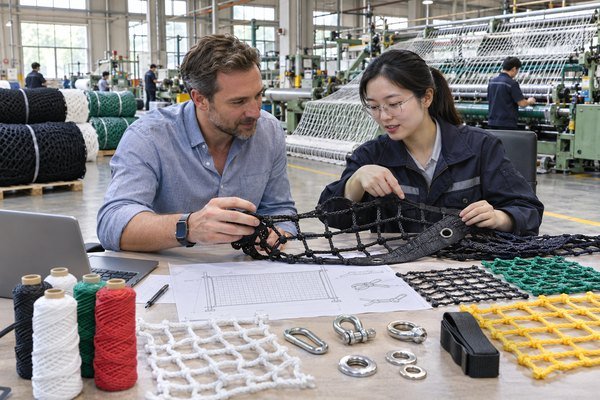
Share your thoughts below. For OEM/ODM inquiries, contact our factory team directly by email or WhatsApp.