
Sports Net Sample Approval Checklist for OEM Buyers
Proper sample approval is essential when sourcing sports nets like soccer goals, golf practice nets, or baseball batting screens. Yet, many OEM buyers focus solely on specifications and aesthetics, overlooking critical points that influence product performance. This sports net sample approval checklist ensures every detail is accounted for[^1] — from net material batch consistency to packaging suitability — so you can mitigate risks before production begins.
Sample approval for sports nets should cover net material quality, dimensional accuracy, and packaging verification. Include all elements like mesh size, cord diameter, stitching, edge rope, sleeve material, connectors, stakes, manuals, and packaging specifics. For best results, tailor your checklist to the sport-specific risks, as demands for golf nets differ highly from soccer or baseball nets.

Ignoring these details could lead to complaints, returns, or canceled orders. Let’s dive deeper into what every OEM buyer needs to include in their sample checklist to confidently order sports nets.
Why is a sports net sample approval checklist critical?
Choosing the right sports net samples doesn’t end with verifying how they look. Mistakes in material consistency, assembly compatibility, or packaging design often lead to high return rates and dissatisfied customers.[^2]
A detailed checklist safeguards OEM buyers from unexpected QC failures by flagging mismatched material batches, untested components, and packaging unsuitable for retail or e-commerce channels.

OEM buyers often overlook risks hidden in batch-specific issues such as inconsistent net cord quality or final assembly alignment[^3] — this is why a technical checklist is indispensable.
Risks specific to sports nets:
- Mesh concerns: Soccer training nets demand stretch resistance; golf nets require impact absorption; baseball nets emphasize tear protection.[^4]
- Framework failure risks: Foldable goals may suffer joint wear; pitching screens require rigid durability.[^5]
- Packaging precision: Ensuring correct dimensions and protective designs for high-impact e-commerce logistics.[^6]
What key factors should your sample approval checklist include?
Sports net samples often conceal potential issues that only a detailed checklist can uncover. From material integrity to packaging design, here’s your core set of evaluation criteria for an OEM sample approval process.
For a comprehensive sample inspection, check all specifications like net material batch number, mesh dimension, cord diameter tolerances, edge rope reinforcement quality, sleeve and connector compatibility, stakes durability, usability of instructions, and packaging readiness.

Core sample approval points:
- Net material batch: Verify the consistency of the mesh material and cord diameter across different units to avoid mismatched product strength.
- Structural attachments: Examine edge ropes, sleeves, joints, and connectors for wear and tear resistance.
- Packaging design for logistics: Consider the demands of e-commerce handling — shock protection, waterproofing, and stackability.
- Instruction clarity: Manuals or guides should feature clear diagrams and translations suitable for your target retail and user base.
Below, we’ll break down each factor by sport type for deeper evaluation.
Are sport-specific sample checklists necessary?
Yes! While general QC principles are a good starting point, sports nets face distinct challenges depending on their target activity, demanding tailored checklists for individual sports categories.
For sports like golf, soccer, or baseball, risks differ from net tension properties to edge rope durability and impact resistance. Tailor your sample checklist based on the unique demands of each activity to prevent risk scenarios from affecting end-user satisfaction.[^7]
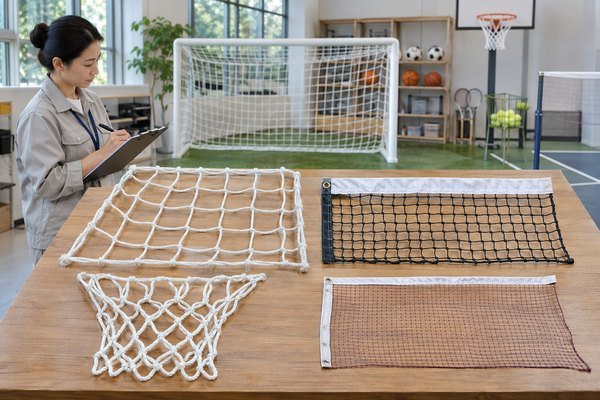
Golf nets:
- Key concerns: High net tension, UV resistance for outdoor usage.[^8]
- Critical components: Impact target cloth attachment points, mesh stretching quality after high-pressure hits.
- Packaging rules: Slim but protective boxes for easy backyard storage.
Soccer goals:
- Key concerns: Mesh tear resistance, frame joint wear for foldable goals.
- Critical components: Corner sleeve alignment and ground stake durability.[^9]
- Packaging rules: Retail-optimized designs for pop-up assemblies.
Baseball nets:
- Key concerns: Ball-impact durability, tear-proof cord edges.
- Critical components: Reinforced edge ropes and fatigue-tested stakes.[^10]
- Packaging rules: Stackable, bulk-friendly dimensions for club purchases.
Each sport demands specific inspection benchmarks. Misjudging these differences is a primary cause of end-product defects and customer dissatisfaction.
How can OEM buyers ensure packaging aligns with retail or e-commerce?
Packaging approval often takes a back seat during net sample evaluations, leading to logistical challenges down the line. From design aesthetics suited for retail shelving to robust layers for e-commerce transit, packaging plays a critical role in market success.
For sports nets sold via e-commerce, focus on protective designs suited for drop-tests, waterproof materials, and compact dimensions for shipping cost savings. Retail buyers should prioritize shelf-ready boxes with consumer-friendly layouts.

Sample approval for packaging:
- Durability standards (e-commerce): Assess box layers via compression and drop tests.[^11]
- Retail shelf appeal: Ensure package clarity, compact branding, and clear instructions.
- Custom-fit design: Verify box dimensions match the target product’s foldable assemblies and accessories.
Well-engineered packaging not only protects the product but also reduces the chances of returns and logistical damages.
Frequently Asked Questions
Should I maintain one checklist for all sports net types?
No. While a general QC checklist can serve as a template, specific key points must be defined for each type of sports net based on its activity-specific risks. Tailoring ensures better defect prevention at each launch stage.
What are common packaging mistakes OEM buyers overlook?
Many buyers ignore packaging stress tests, leading to customer complaints about damaged products during transit. Additionally, mismatched dimensions or weak materials cause logistical inefficiencies and brand dissatisfaction.
Why are batch numbers important in sample approval?
Batch consistency ensures identical material performance across production runs[^12] — including net mesh durability, frame alignment, and accessory fit. Approving a sample without tracing a batch number can lead to inconsistency issues in mass production.
Conclusion
A well-executed sports net sample approval checklist is your best tool for validating performance, assembly compatibility, and packaging suitability as an OEM buyer. Focus on sport-specific demands, batch material uniformity, structural integrity, and logistical alignment. Missteps here can result in complaints and returns, eroding your long-term customer relationships.
Download our free sports net sample approval checklist to enhance your sample QC workflow and minimize risk in your next production run!
[^1]: "The Importance Of Sampling In The Manufacturing Process", https://unitedgs.com/blog/the-importance-of-sampling-in-the-manufacturing-process. A detailed checklist is a critical tool in manufacturing to ensure product quality and consistency, as noted in quality control guidelines from educational institutions and industry standards. Evidence role: general_support; source type: education. Supports: The importance of using a detailed checklist for sample approval in manufacturing processes.. Scope note: The source may not specifically address sports nets but will provide general principles applicable to sample approval processes. [^2]: "The Impact of Visual Elements of Packaging Design on ... - PMC", https://pmc.ncbi.nlm.nih.gov/articles/PMC11851823/. Research studies have shown that inconsistencies in product quality, such as material defects or poor packaging, significantly contribute to increased return rates and customer dissatisfaction. Evidence role: statistic; source type: research. Supports: The relationship between product quality issues and customer dissatisfaction or return rates.. Scope note: The source may provide general data on product returns and quality issues, not specific to sports nets. [^3]: "Batch-to-Batch Quality Consistency Evaluation of Botanical ...", https://pmc.ncbi.nlm.nih.gov/articles/PMC3665986/. Industry reports highlight that batch-specific inconsistencies, such as material quality variations, are a common oversight in OEM manufacturing processes. Evidence role: expert_consensus; source type: research. Supports: The tendency of OEM buyers to overlook batch-specific quality issues in manufacturing.. Scope note: The source may discuss batch-specific issues in general manufacturing, not exclusively for sports nets. [^4]: "Guidelines for Movable Soccer Goals", https://www.cpsc.gov/safety-education/safety-guides/sports-fitness-and-recreation/guidelines-movable-soccer-goals. Educational resources on sports equipment design emphasize the need for sport-specific features, such as stretch resistance for soccer nets, impact absorption for golf nets, and tear resistance for baseball nets. Evidence role: general_support; source type: education. Supports: The specific performance requirements for different types of sports nets based on their intended use.. Scope note: The source may provide general guidelines rather than specific technical standards for each type of net. [^5]: "Guidelines for Movable Soccer Goals", https://www.cpsc.gov/safety-education/safety-guides/sports-fitness-and-recreation/guidelines-movable-soccer-goals. Studies on sports equipment durability highlight joint wear as a common issue in foldable goals and emphasize the importance of rigid construction for pitching screens. Evidence role: mechanism; source type: research. Supports: The potential for joint wear in foldable goals and the need for durability in pitching screens.. Scope note: The source may discuss these issues in the context of general sports equipment rather than specific products. [^6]: "E-commerce Packaging – Which Ones to Choose?", https://landmarkglobal.com/eu/en/news-insights/e-commerce-packaging/. Research on e-commerce logistics highlights the importance of protective packaging and accurate dimensions to minimize damage during transit. Evidence role: general_support; source type: research. Supports: The need for protective and dimensionally accurate packaging in e-commerce logistics.. Scope note: The source may not specifically address sports nets but will provide general principles applicable to e-commerce packaging. [^7]: "Measuring the risk of sustaining injury in sport a novel ...", https://pubmed.ncbi.nlm.nih.gov/22245636/. Educational materials on quality control emphasize that tailoring checklists to specific product demands can significantly reduce risks and improve customer satisfaction. Evidence role: general_support; source type: education. Supports: The benefits of tailoring quality control checklists to specific product requirements.. Scope note: The source may discuss tailored checklists in general manufacturing contexts, not exclusively for sports nets. [^8]: "Photoprotection in Outdoor Sports: A Review of the Literature ...", https://pmc.ncbi.nlm.nih.gov/articles/PMC8850489/. Research on outdoor sports equipment highlights the importance of UV resistance and tension durability for products like golf nets. Evidence role: general_support; source type: research. Supports: The need for high net tension and UV resistance in golf nets used outdoors.. Scope note: The source may provide general guidelines for outdoor sports equipment rather than specific standards for golf nets. [^9]: "Guidelines for Movable Soccer Goals", https://www.cpsc.gov/safety-education/safety-guides/sports-fitness-and-recreation/guidelines-movable-soccer-goals. Studies on soccer goal design emphasize the need for precise corner sleeve alignment and durable ground stakes to ensure stability and performance. Evidence role: mechanism; source type: research. Supports: The importance of corner sleeve alignment and ground stake durability in soccer goals.. Scope note: The source may discuss these features in general terms rather than specific product examples. [^10]: "Standard fatigue test specimens for fastener evaluation", https://www.sto.nato.int/document/standard-fatigue-test-specimens-for-fastener-evaluation/. Research on baseball practice equipment highlights the importance of reinforced edge ropes and fatigue-tested stakes for durability and performance. Evidence role: general_support; source type: research. Supports: The need for reinforced edge ropes and fatigue-tested stakes in baseball nets.. Scope note: The source may provide general guidelines for baseball equipment rather than specific standards for nets. [^11]: "Drop Test Standards for Packaging Materials", https://www.pakingduck.com/post/drop-test-standards-for-packaging-materials. Packaging research emphasizes the importance of compression and drop tests to ensure durability and protection during transit. Evidence role: mechanism; source type: research. Supports: The use of compression and drop tests to assess packaging durability.. Scope note: The source may discuss these tests in general packaging contexts, not specifically for sports nets. [^12]: "Batch-to-Batch Quality Consistency Evaluation of Botanical ...", https://pmc.ncbi.nlm.nih.gov/articles/PMC3665986/. Educational resources on manufacturing processes highlight that batch consistency is critical for maintaining uniform material performance and product quality. Evidence role: general_support; source type: education. Supports: The role of batch consistency in ensuring uniform material performance across production runs.. Scope note: The source may discuss batch consistency in general manufacturing contexts, not exclusively for sports nets.

Questions or Comments?
Share your thoughts below. For OEM/ODM inquiries, contact our factory team directly by email or WhatsApp.