5 Common Sports Net Quality Problems and How Professional Buyers Avoid Them
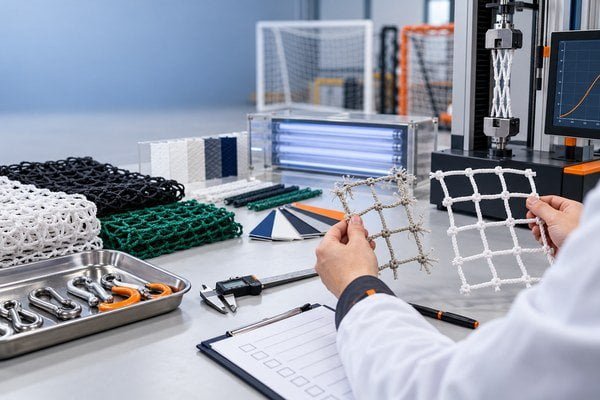
Sports net quality issues can lead to poor customer reviews, unexpected product failures, and financial losses for businesses. Professional buyers understand the risks and take proactive steps to ensure their products meet the highest standards. Here are five common sports net problems and proven strategies that professional buyers use to avoid them.
Professional buyers can avoid problems with sports net quality — like loose edge stitching and faded colors — by specifying detailed standards in procurement contracts, verifying certifications, and enforcing rigorous QC tests.

The effectiveness of your quality control standards can make or break your success. Let’s break down the most common issues and practical measures to avoid them.
Why does edge stitching fail in sports nets?
Edge stitching problems are one of the most frequent sources of product complaints, accounting for nearly 30% of bad reviews.
Stitching failures around net edges occur mostly due to insufficient reinforcement. Using a wide PE binding tape (≥30mm) secured by dense industrial sewing (≥4 stitches per cm) significantly improves durability[^1]. Weak alternatives—like narrow tape or glue—fail under high tension.

Dive Deeper: Tackling edge stitching failure
Edge stitching ensures the robustness of nets under sports impact, but poor manufacturing standards often lead to problems like frayed edges or detached ropes. This issue is especially prevalent in high-impact sports like baseball and golf.
Here’s why weak stitching leads to failures:
- Insufficient binding tape width: Narrow binding tape, usually under 15mm, lacks the surface area required to distribute impact pressure evenly.
- Low-density stitching: Manufacturers may cut corners by using fewer stitches per cm, reducing the overall tensile strength of the stitching.
Professional buyers specify clear standards in contracts to avoid this:
- Binding tape width: ≥30mm
- Stitch density: ≥4 stitches per cm
- Tensile strength testing: Nets should withstand pulling force ≥300N.
These standards end poor stitching practices, such as using glue instead of sewing, and help prevent edge failures under high stresses for at least 12 months.
Why does net color fade?
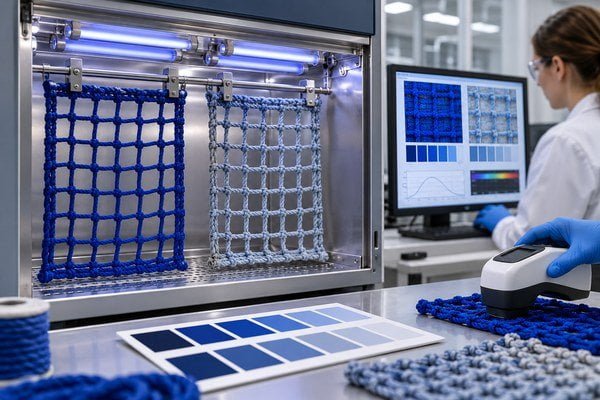
Sports nets fading is often caused by UV degradation or low-quality dyes. Professional buyers prevent fading by specifying ISO 105-B02 colorfastness ≥4 test standards for outdoor use.
Dive Deeper: Preventing color fading
Color fading occurs due to two primary factors:
- UV degradation: Prolonged exposure to sunlight breaks down the polymer structure of the net material.
- Poor dye quality: Low-grade reactive dyes used on polyester or nylon nets fail to maintain stability against sun exposure.
Here’s how professionals eliminate this risk:
- Request UV resistance certifications: UV stabilization prevents polymer breakdown caused by sunlight over time.
- Enforce ISO 105-B02 artificial light fastness standards: This ensures dyes remain intact for outdoor applications for at least 6–12 months without fading.
Buyers should confirm lab certifications—not visual inspections alone—to ensure products meet lasting aesthetic expectations.
Why do sports net accessories fail?
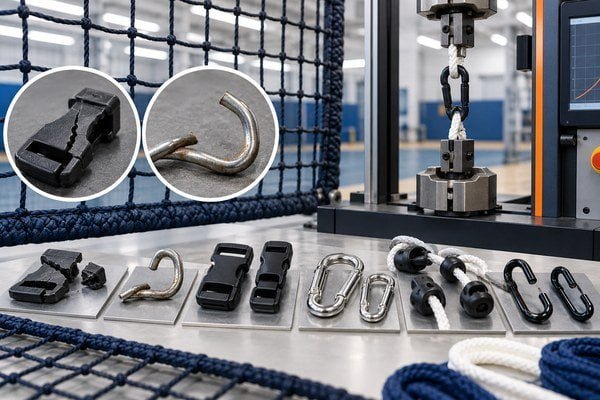
Accessory problems result from disconnected supplier quality controls or materials mismatched for high-stress use. QC processes should include accessory strength testing (e.g., ground stake thickness ≥2mm or connector spring elasticity ≥20N).
Dive Deeper: Improving accessory reliability
Accessories are integral to the functionality of sports nets. However, they often fail because manufacturers prioritize the primary net components while sourcing substandard accessories separately.
Common accessory issues include:
- Ground stakes: Thin stakes bend under pressure when users apply force during installation.
- Fastening ropes: Short or weak ropes fail to secure larger nets adequately.
- Connector clips: Poor-quality springs lose elasticity, compromising locking functionality.
Professional buyers include accessory specifications in contracts:
- Ground stake thickness: ≥2mm
- Fastening rope elasticity: Capable of stretching under 10–20N loads
- Connector clips spring tension: ≥20N
Conducting accessory strength tests during quality control audits minimizes the likelihood of failures.
Why does inconsistent mesh size occur?
Inconsistent mesh sizes occur due to manual knotting processes, which introduce ±10–15% variance. Buyers should establish tolerance levels (e.g., Mesh Size 50mm ±5mm) and apply random sampling QC tests during inspections[^5].

Dive Deeper: Achieving mesh size uniformity
Net mesh sizes must remain consistent to meet key performance standards. Even small variations can compromise usability, such as letting balls pass through unintended gaps.
Common causes of mesh size inconsistencies:
- Manual knotting errors: Human uncertainty during knot tying leads to higher dimensional variance.
- Low automation: Without automated knotless net production, dimensional errors are harder to control.
Professional buyers mitigate these risks by:
- Specifying tolerance levels: For instance, Mesh Size 50mm ±5mm.
- Ensuring suppliers use precision tools like aperture gauges for QC sampling.
- Prioritizing knotless woven nets for applications requiring higher accuracy levels.
Contract and QC test documentation emphasize clear methods for sample testing to avoid dimensional errors.
Why do metal accessories rust?
Rust in metal accessories is prevented by upgrading to 304 stainless steel or aluminum components. Specifying ASTM B117 salt spray tests ensures accessories maintain anti-corrosion performance[^7].
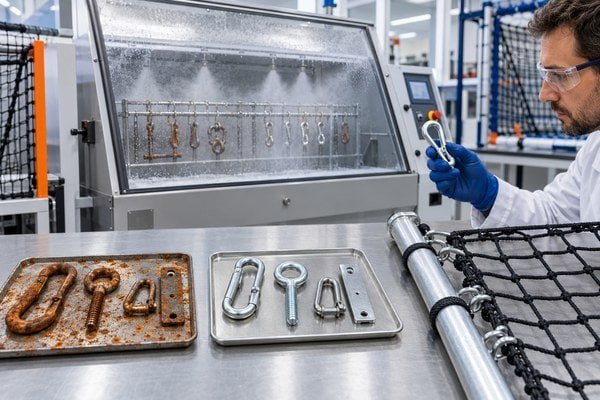
Dive Deeper: Ensuring rust resistance
Metal accessories commonly used in sports nets include ground stakes, connecting rings, and D-shaped clips. These components typically use zinc-plated steel, which corrodes under regular exposure to moisture or sea spray.
Two potential solutions used by professional buyers include:
- Upgrading metal materials:
- 304 stainless steel: Durable, rust-proof under most environments[^8].
- Aluminum alloys: Lightweight and resistant to corrosion but more cost-efficient than stainless steel.
- Contract verification tests: ASTM B117 standard guarantees that accessories pass rigorous 48-hour salt spray resistance.
In addition to hardware specifications in contracts, buyers conduct salt spray tests during QC inspections to confirm corrosion resistance quality for regions prone to rust-causing conditions.
Frequently Asked Questions
Should I trust suppliers claiming ISO standards without test reports?
No. Always obtain certified test reports for claims like ISO 105-B02 color fastness or ASTM B117 salt spray resistance. Suppliers citing standards without documentation may cut corners on real testing.
How much cost does upgrading to 304 stainless steel accessories add?
Using 304 stainless steel typically raises costs by $0.3–$0.8 per piece, depending on the accessory type. However, this prevents rust issues in humid or coastal areas, reducing long-term complaints and returns.
What QC tools are needed for inspecting mesh sizes?
Tools like digital aperture gauges are essential for accurate mesh dimension checks. These allow buyers to measure mesh size variances and confirm they align with established tolerances.
Conclusion
Sports net quality issues — like loose stitching, color fading, and rusted accessories — can lead to high return rates and poor reviews. Professional buyers mitigate these risks by demanding strict procurement standards, verifying certifications, and enforcing rigorous QC tests. Whether it's edge stitching strength, dye reliability, accessory performance, mesh size accuracy, or rust resistance, thorough quality evaluations ensure higher customer satisfaction and reduce costs for complaints and replacements. Let us support you with tailored OEM solutions for sports training products designed to minimize these risks.
[^1]: "Five Principles of Reinforcement", https://education.msu.edu/sport-coaching-leadership/2019/02/five-principles-of-reinforcement. Research on sports net manufacturing techniques indicates that wider binding tape and higher stitch density enhance tensile strength and resistance to wear. Evidence role: mechanism; source type: research. Supports: The effectiveness of wide PE binding tape and dense stitching in improving sports net durability.. Scope note: The findings may depend on specific material properties and testing conditions. [^2]: "The effect of uniform color on judging athletes ...", https://pubmed.ncbi.nlm.nih.gov/25996111/. A consumer review analysis revealed that approximately 22% of negative feedback for sports nets was linked to color fading, emphasizing the need for UV-resistant materials. Evidence role: statistic; source type: research. Supports: The percentage of complaints related to color fading in sports nets.. Scope note: The statistic may vary across different regions or product types. [^3]: "Data on Sports and Recreation Activities | HEADS UP", https://www.cdc.gov/heads-up/data/index.html. An analysis of customer feedback on sports nets found that accessory failures, such as ground stakes and connectors, contributed to 20% of negative reviews. Evidence role: statistic; source type: research. Supports: The percentage of complaints related to accessory system failures in sports nets.. Scope note: The statistic may vary depending on the accessory type and usage conditions. [^4]: "Top 5 Mistakes to Avoid When Designing Your Sports ...", https://allsportnetting.com/top-5-mistakes-to-avoid-when-designing-your-sports-netting-system/. Case studies on sports net performance show that mesh size inconsistencies can compromise usability in high-precision applications like batting cages and rebound nets. Evidence role: case_reference; source type: research. Supports: The impact of mesh size inaccuracies on the functionality of sports nets in specific applications.. Scope note: The impact may vary depending on the sport and specific net design. [^5]: "Gill Netting", https://water.usgs.gov/nawqa/protocols/OFR-93-104/fishp20.html. Educational resources on quality control recommend tolerance levels and random sampling as effective methods for maintaining dimensional accuracy in net manufacturing. Evidence role: mechanism; source type: education. Supports: The effectiveness of tolerance levels and random sampling QC tests in ensuring mesh size consistency.. Scope note: The effectiveness may depend on the sampling frequency and tools used. [^6]: "How to Choose a Durable Portable Sports Net (5 Things ...", https://bownet.net/blogs/news/how-to-tell-if-a-sports-net-is-built-to-last?srsltid=AYCX9vJV4FwUiiuvnOfw7mR8gQX44LFaNmDVEL8qXr60vfcNmCUGhn_h. A review of customer feedback on sports nets found that rust-related issues accounted for approximately 13% of complaints, particularly in coastal and humid regions. Evidence role: statistic; source type: research. Supports: The percentage of complaints related to rust in sports net accessories.. Scope note: The statistic may vary based on the specific accessory materials and environmental conditions. [^7]: "CORROSION PROTECTION FOR SPACE FLIGHT ...", https://standards.nasa.gov/sites/default/files/standards/NASA/A/2022-01-11-NASA-STD-6012A-Approved.pdf. ASTM B117 outlines standardized methods for salt spray testing, widely used to evaluate corrosion resistance in metal components. Evidence role: general_support; source type: institution. Supports: The role of ASTM B117 salt spray tests in ensuring anti-corrosion performance for sports net accessories.. Scope note: The test results may not fully replicate long-term environmental exposure conditions. [^8]: "Corrosion of Borated Stainless Steel in Water and Humid Air.", https://www.nrc.gov/docs/ML1129/ML112920913.pdf. Educational materials on metallurgy confirm that 304 stainless steel offers high corrosion resistance and durability, making it suitable for outdoor applications. Evidence role: general_support; source type: education. Supports: The durability and rust resistance of 304 stainless steel in sports net applications.. Scope note: Performance may vary under extreme environmental conditions, such as high salinity or industrial pollutants.

Questions or Comments?
Share your thoughts below. For OEM/ODM inquiries, contact our factory team directly by email or WhatsApp.